
DaS™ – Agentic
Build on COMBINED Design EXPERIENCE.
Welcome to the "New Era," an Agentic Design Leader—the architect focused on designing for autonomous AI agents and complex systems — the role that requires us to bridge the gap between human intuition and machine autonomy.
This role is no longer just about aesthetics; it is about architecting trust, managing system-wide behaviour, and driving fiscal growth through automated intelligence.
I-Shaped
An I-shaped individual possesses deep expertise and specialised knowledge in a specific field or domain– like typography, branding, research, or user experience and lately design systems. A narrow yet profound skill set is often developed through dedication and extensive practice. We call them subject matter experts, in other words, principals. It is profoundly mistaken to assume that their expertise limits their ability to integrate and adapt within a wider organisation. The opposite is true.
T-Shaped
A T-shaped individual combines deep expertise in one specific area with an integration of design function within the organisation. These leaders often rely on a strong foundation in their specialised expertise, yet extend their knowledge and shape their skills into related areas. Because they can span multiple disciplines, T-shaped individuals thrive in collaborative, interdisciplinary settings. They communicate effectively with diverse teams and bring a holistic perspective to problem-solving.
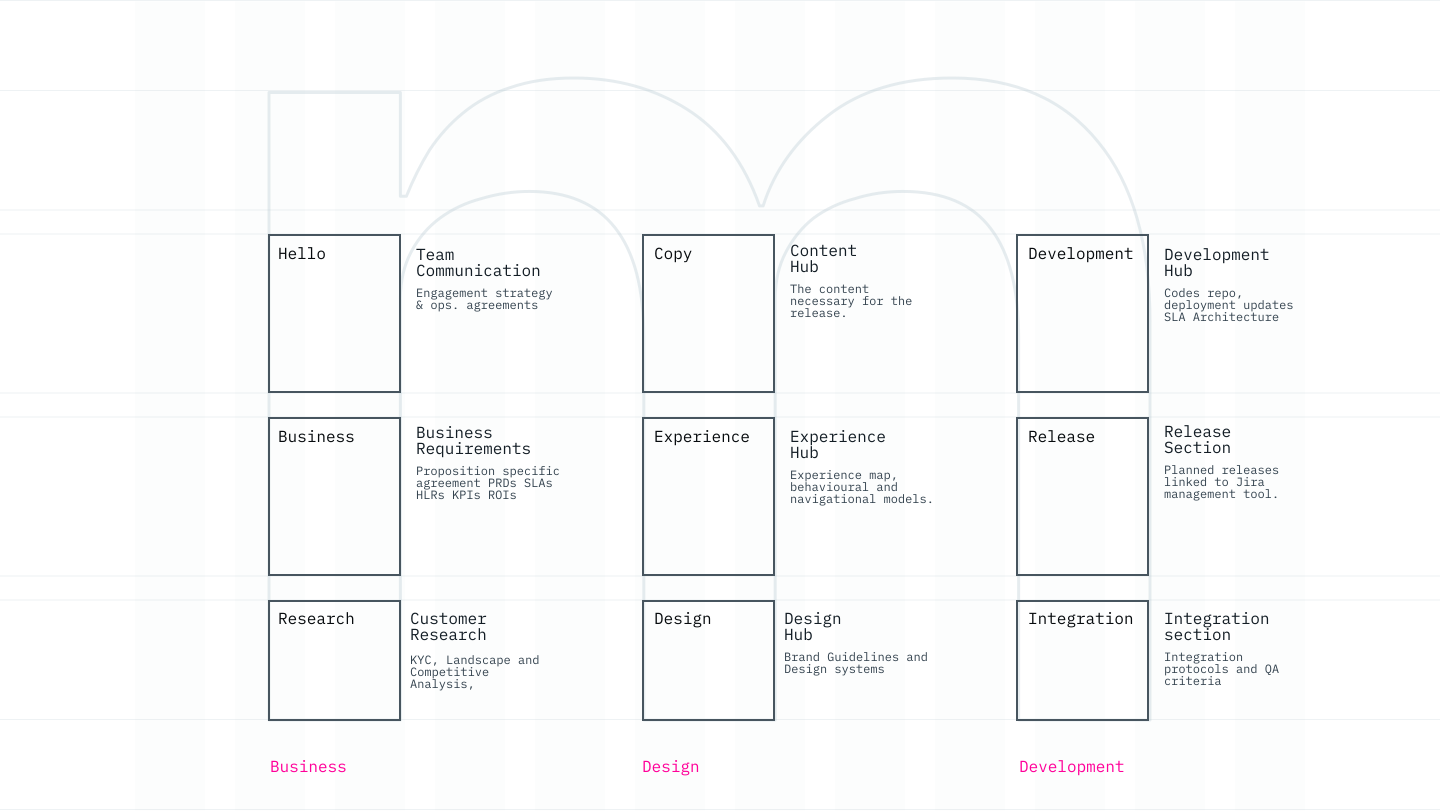
How far does the Agentic Design Leader need to go to thrive in the new design era?
M-shaped people are often equipped with an I-shaped discipline knowledge at the principal level, with depth across multiple complementary areas of expertise, tested in vastly different environments. Their cross-functional expertise and holistic thinking yield pragmatic, durable solutions that can be delivered with less tension and faster, leading to sustainable outcomes for your business. This depth and business-wide, integrated understanding enable an agile, adaptable approach that can look beyond the immediate issue to see the bigger picture.
To choose the right candidate for your team, we cannot evaluate designers using an outdated matrix.
That is why we have asked our network of +90 Design Directors in FSTE100 companies who shape the digital products and services across aviation, logistics, transportation, education, manufacturing, broadcast and finance.
We deliberately asked the question in the three main pillars of the m-shaped leader. Not what they want from their peers, but how they shape themselves to shape others, which led to a series of extended questionnaires for existing employees and new candidates.
30 Questions
Business & Strategy.
Focus
Aligning agentic systems with market viability and corporate fiscal health.
ROI
KPI
Customer Lifetime Value (CLV) and Market Share Expansion.
Agentic Design Leader connects the dots through efficiency, pragmatic approach, and operational cost reduction ranging from 18-32%. Enabling business partners to make informed, data-driven decisions.
1. How do you define the "Unit Economics" of an agentic user experience?
2. In a shift from SaaS to AaaS (Agent-as-a-Service), how do you adjust our pricing strategy?
3. What is your 30-60-90-day plan to reduce churn using proactive agentic intervention?
4. How do you balance the cost of LLM calls against the perceived value of the UI?
5. Describe a time you killed a high-fidelity project because the business ROI didn’t scale.
6. How do agentic workflows impact our customer acquisition cost (CAC)?
7. How do you pitch the "Human-in-the-loop" model to stakeholders worried about headcount reduction?
8. What is the relationship between agent autonomy and brand liability?
9. How do we measure the "Return on Intent" when a user delegates a task to an agent?
10. How do you identify which business processes are "agent-ready" versus "human-only"?
11. How does agentic design contribute to our competitive moat in a saturated market?
12. How do you translate "user delight" into a hard currency metric for the board?
13. If an agent fails a transaction, how do we calculate the "Trust Debt" in dollars?
14. How do you prioritise "General Intelligence" features vs. "Vertical-Specific" agents?
15. What is your strategy for managing "Hallucination Risk" from a business perspective?
16. How do we transition our current "Point-and-Click" into "Command-and-Delegate" users?
17. How you’d use agentic design to open a new revenue stream in the next 12 months?
18. How do you audit the ethical implications of agents to avoid regulatory fines?
19. How do you align design sprints with the fluctuating costs of token usage?
20. What is the ROI of investing in a proprietary Design System for Agents vs. using off-the-shelf components?
21. How do you handle a scenario where an agent discovers a more efficient business process than the one we sell?
22. How do we measure the productivity gain of our internal teams using the agents you design?
23. What is the impact of "Agentic Latency" on our conversion funnels?
24. How do you design for "Graceful Failure" to protect the bottom line?
25. How do you evaluate "Buy vs. Build" for agent orchestration layers?
26. What is your approach to "Cross-Selling" through autonomous agent recommendations?
27. How does your design philosophy prevent "Feature Creep" in an AI-driven environment?
28. How do you use data from agent failures to pivot the product strategy?
29. What are the top three KPIs you would present at a Quarterly Business Review (QBR)?
30. How do you ensure the agent's "Personality" reflects the company's fiscal values?
30 Questions
Design & Experience.
Focus
Crafting trust, transparency, and seamless delegation in agentic interfaces.
ROI
Increased user retention and lower support ticket volume.
KPI
Agentic Design Leader enables the design function to be completely integrated with the core business units. From central governance to self-organised teams.
1. What is the "Atomic Unit" of design in an agentic system?
2. How do you design for "Intermittent Control" where the user only intervenes occasionally?
3. How do you visualise an agent's "Thought Process" without overwhelming the user?
4. Describe the design patterns for "Multi-Agent Collaboration" in a single UI.
5. How do you design for "Uncertainty"? What does a 60% confidence interval look like?
6. How do we move beyond the "Chat Bubble" for agentic interaction?
7. What is your approach to "Anticipatory Design" in the context of autonomous actions?
8. How do you design an "Off-Ramp" for when an agent needs to hand a task back to a human?
9. How do you handle "Context Drift" in long-term user-agent relationships?
10. What role does "Motion Design" play in signalling agent activity or status?
11. How do you design for "Permissions" when an agent acts on a user's behalf?
12. How do you test a UI that changes dynamically based on agent reasoning?
13. Describe your process for "Red Teaming" a user experience for potential abuse.
14. How do you ensure "Accessibility" in a voice-first or command-first agentic world?
15. What is the "Hero State" of an agent that is working in the background?
16. How do you design for "Verification"? How does a user quickly audit an agent's work?
17. How do you handle "Conflicting Intents" between two different agents?
18. What is the "Minimum Viable Trust" required to launch an autonomous feature?
19. How do you design for "Error Recovery" when the agent doesn't realise it made a mistake?
20. How do you use "Skeuomorphism" or "Metaphor" to explain complex AI agents to novices?
21. How do you design "Feedback Loops" that actually improve the underlying model?
22. What is your stance on "Anthropomorphism" in agentic design?
23. How do you design for "Privacy-by-Design" in a system that needs deep user data to work?
24. How do you visualise "Agent Memory" so the user knows what the system remembers?
25. Describe the "Onboarding" process for an agent that learns over time.
26. How do you design for "Global vs. Local" agent settings?
27. How do you ensure "Visual Consistency" when an agent generates its own UI components?
28. What is the design impact of "Token Limits" on information density?
29. How do you measure "Cognitive Load" in an environment where the agent does 90% of the work?
30. How do you design for the "Long Tail" of edge cases in agentic behaviour?
30 Questions
Development & Engineering.
Focus
System architecture, scalability, and the technical feasibility of design.
ROI
Lower technical debt and optimised cloud/compute costs.
KPI
System Latency and Mean Time to Recovery (MTTR).
Agentic Design Leader minimises design & technical debt by optimising handoffs to a minimum through the integrated code foundation.
1. How do you bridge the gap between "Design Tokens" and "Model Weights"?
2. What is your experience with "Orchestration Frameworks" (e.g., LangChain, AutoGPT)?
3. How do you design for "Real-time Streaming" vs. "Batch Processing" in the UI?
4. How do you collaborate with Eng to set "Latency Budgets" for agentic responses?
5. What is your strategy for "Versioning" an agentic UI when the underlying LLM changes?
6. How do you handle "State Management" across distributed agentic workflows?
7. What is your approach to "Offline-First" agentic experiences?
8. How do you design for "API-First" agents that may not have a traditional frontend?
9. How do you work with engineers to implement "Guardrails" at the code level?
10. Describe the "Evaluation Pipeline" for a design change in an agentic system.
11. How do you balance "Deterministic" code with "Probabilistic" AI outputs?
12. What is the impact of "Vector Databases" on the design of search and retrieval?
13. How do you handle "Prompt Injection" protection from a UX/Engineering standpoint?
14. How do you design for "Multi-Modal" inputs (Image, Text, Voice) at the data layer?
15. What is your strategy for "Caching" agentic responses to save on compute?
16. How do you ensure "Telemetry" is captured for every agent-user interaction?
17. How do you design "Tool-Use" (Function Calling) interfaces for agents?
18. How do you manage "Dependency Hell" in a multi-agent ecosystem?
19. What is the "Infrastructure Cost" of the design features you are proposing?
20. How do you handle "Model Degradation" (drift) and its effect on the UI?
21. What is your approach to "A/B Testing" in a non-deterministic environment?
22. How do you design "Sandbox Environments" for users to test agents?
23. How do you work with Devs to minimise the "Cold Start" problem for agents?
24. What is your philosophy on "Open Source vs. Closed Source" models for our stack?
25. How do you design "Audit Logs" that are both human-readable and machine-parsable?
26. How do you manage "Asynchronous Updates" in a collaborative agentic UI?
27. What is the role of "Webhooks" in your agentic design strategy?
28. How do you ensure "Scalability" when an agent needs to perform 1,000 tasks at once?
29. How do you design for "Compliance" (GDPR/SOC2) in agentic data flows?
30. How do you define the "Hand-off" documentation from Design to Engineering in this era?
For Takers
Download
Download a free copy in PDF format and integrate it with your design team. No strings attached, this is your journey upwards. As you'll be using one of the Design at Scale™ products, you'll be automatically added to our monthly newsletter, where we share updates and useful case studies from our partners that use Design at Scale to grow their businesses.

Include PDF with all questions
For Givers
Contribute
Design at Scale™ is not a fixed proposition baked in diamonds; we evolve, adjust and grow with organisations we support. If you wish to challenge, change, adjust, debate or just share your opinion, feel free to join the community of like-minded individuals that shape future organisation through design.
Powered by Circle.so
090
At Design at Scale™ we test all our ideas with trusted specialist.
Students
5K
Knowledge
20Y
Dare to Scale
Design is on it’s pivotal point. Speed, strategy, thinking, craft, complexity, systemisation and the overall integration made design function 20x faster than 30 years ago. What is the next chapter of design?

Design at Scale™: How Individuals Shape Future Organisation Through Design
Design at Scale™

Categories
Data
Share
Internal
Collaborate
Resources
IBM PlexSan
Regular
Charcoal
Design at Scale™ is defined by three models, which form the Method. Each model operates in a different part of the business and collects and informs parties on design and engineering decisions that have a direct impact on the delivery.
All brands and trademarks presented on the Design at Scale™ website are owned by their relevant companies or agencies. The projects represent collaborations between designers, developers and product owners. Do not copy or publish any of the projects shown here without written approval from Design at Scale™ (alternatively GIVE™, 9V™) and/or relevant companies and agencies.


