

How design leaders reshape old design departments by shifting from negotiating features to broadcasting direction, reducing risk, saving on operational cost, while strengthening tribal leadership in an exponential organisation. Find out in the course.
Disclaimer – The department/corporation sessions are here to help all individuals thrive innavigatong in navigating a unilateral decision-making between departments and business units.
Team on One Hundred.
In the "Team of One Hundred", everything is in transition: your role, your product, your deadline, your budget, your team, and your boss's promotion. The acceleration changes are faster than you can keep track of. How do we create and maintain thought leadership in constantly evolving environments?

Webinar
3-in-1
3-hour webinar tailored for middle management and heads of departments building joined products and services in organisations with +50 designers in a joined department striving for operational excellence.
From
Being a designer in a large organisation is often seen as an exhausting job. We asked: Why is that? The answer: “we are not heard”, “we are misunderstood”, “the businesses take us for granted”, or, worse, “we just colour things in”. The majority of design leaders report that our business does not recognise the value of design, and we are not really a customer-centric company after all.
To
Design delivery in complex environments is really just a simple sequence of tasks that need to be completed reasonably well in the allocated time. The session is reshaping design leadership from pure delivery to broadcast. It is about providing clarity, transparency and reducing the risk of collaborating units that contribute to design function. All Organisation Delivery Model, combined withDesign at Scale™, provides a foundation for unilateral decision-making within the newly formed Exponential Organisation.
01
Structure.
Matrix.
Function.
02
Agile Org.
Reactive.
Broadcast.
03
Transparency.
Everybody.
One Team.
Dare to Scale

The 3-hour workshop is divided into Mobilise, Operate, and Accelerate stages. A series of short presentations and tasks allowing all participants to collectively summarise their greatest challenges and reframe their own understanding of design in their organisation. All participants will have access to the Design at Scale™ Supply (Figma) library, allowing them reuse all our materials for their own ventures. This includes access to our newly established community.
Individual – workshop/webinar is open to all participants from different organisations. This course is designed to be more high-level, covering common themes and how to address them effectively in a short period of time.
Companies – a physical workshop/webinar is open to all companies facing overload or stagnation of the design function within the organisation. This session is often held at company offices and addresses very specific challenges the company is facing.
Cost
£990
Syllabus.
Every organisation faces a technological transition, where clarity beats speed for breakfast. We empower your team to make unilateral decisions in a complex environment that shapes future organisations through design.
Course.

Course
Supplies
KeyTakeaway_ACD100.fig
Foundation

Integratioon

Business
.doc
Design
.fig
Development
.fig
2010
2024
Resources
On Business
On Structure
On Value
On Function
On Department
Resources
On Agile
On Org.
On Reactivity
On Protecting
On Broadcast
Resources
Be Transparent
On Designer
On Colleagues
On Team
On Scale
The
Imact.
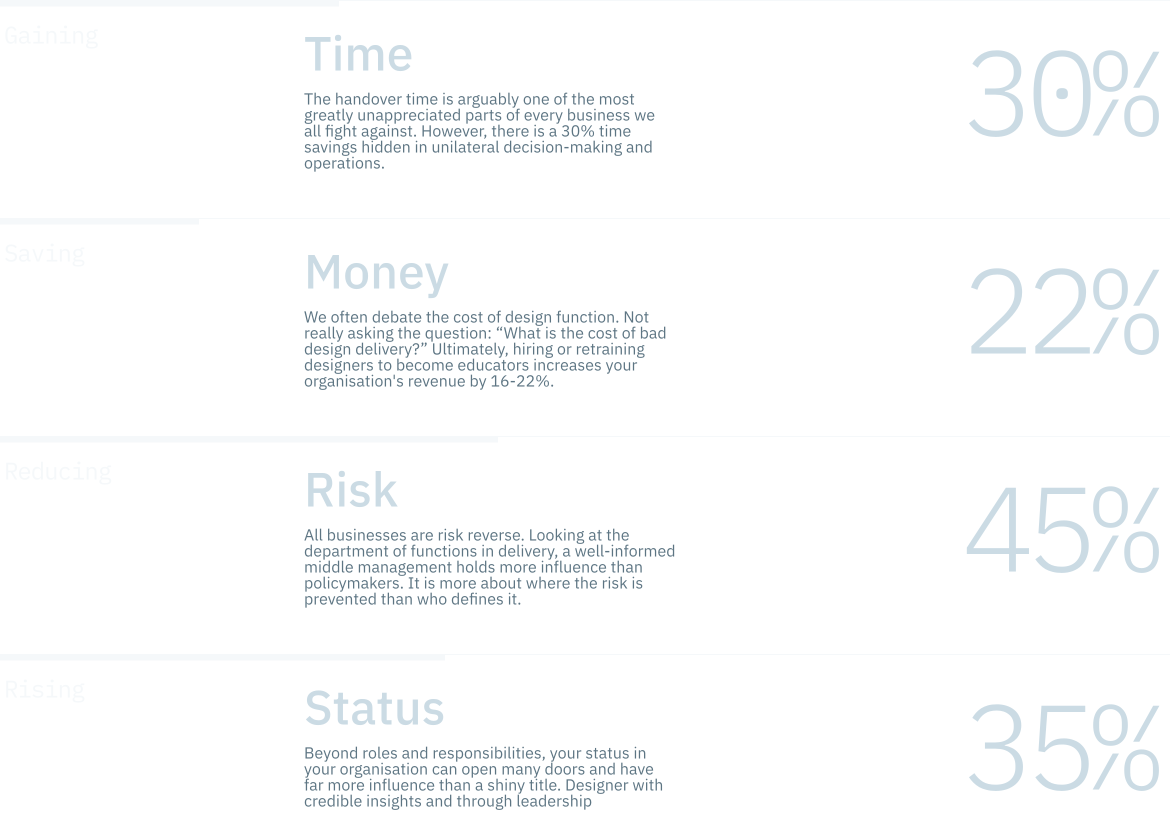
We can summarise the value of design in four areas: time, money, risk, and status. Whether your ambition is to increase it or decrease it, we make sure the fundamentals stay in your control.
Our References.
Selected a few who had a chance to work with us over the years and make their design journey worth pursuing.


Design
at Scale™
Categories
Data
Share
Internal
Collaborate
Resources
IBM PlexSan
Regular
Charcoal
Design at Scale™ is defined by three models, which form the Method. Each model operates in a different part of the business and collects and informs parties on design and engineering decisions that have a direct impact on the delivery.
All brands and trademarks presented on the Design at Scale™ website are owned by their relevant companies or agencies. The projects represent collaborations between designers, developers and product owners. Do not copy or publish any of the projects shown here without written approval from Design at Scale™ (alternatively GIVE™, 9V™) and/or relevant companies and agencies.


