
DaS™ – Journey Transformation
About Scaling Design Propositions.
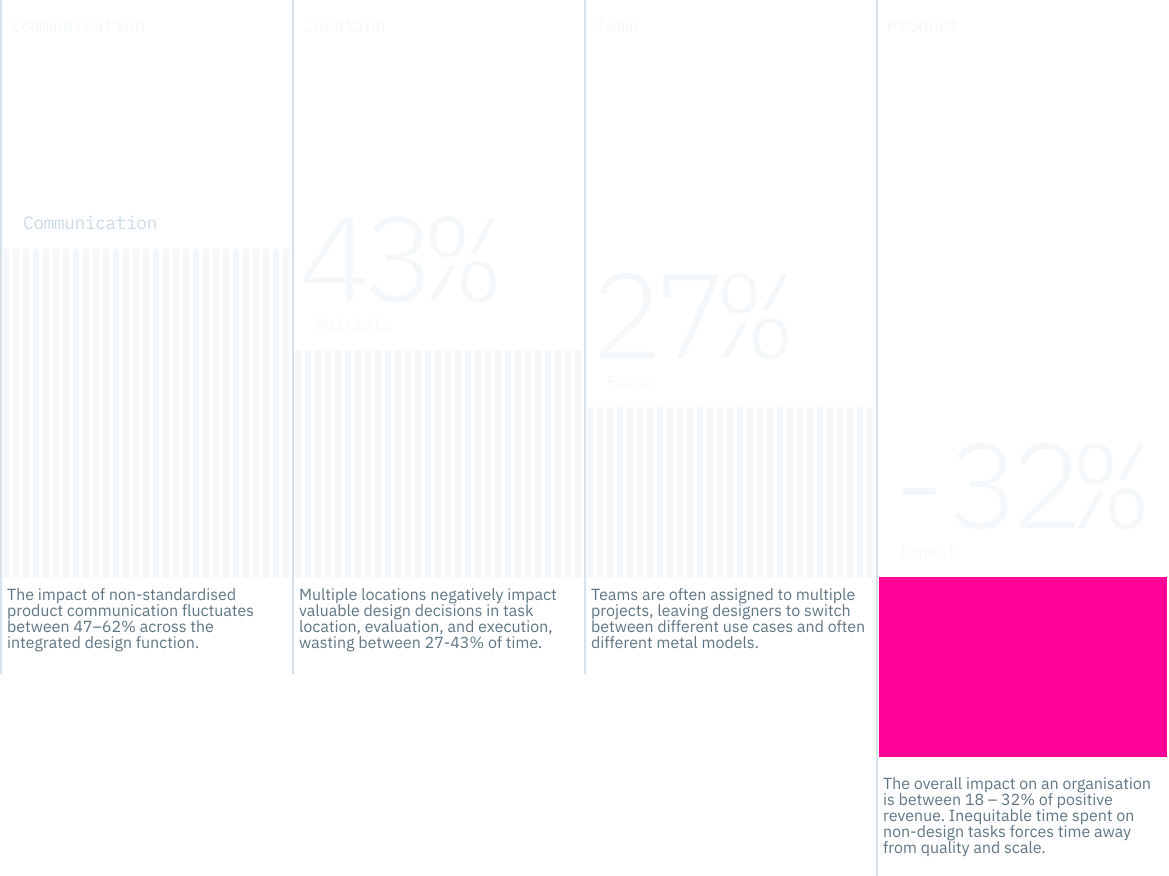
With an increasing number of communication points, multiple locations for storing our artefacts, and the multiplicity of projects we can address simultaneously, we reached a point of saturation and lost context for our design decisions.
How might we have a sense of direction, continuity, progress, delivery, and integration reflect endless choices in conjunction with the data to achieve significant, transparent, scalable and robust outcomes.

The Design Maturity Matrix is a simple, eyes-only assessment of how well your organisation integrates design function. You can apply it by yourself. Alternatively, you can reach out for help.

How did we get here
Landcape.
The design delivery has forever changed. The hundred years of static graphics are now transforming into dynamic and forever-changing environments driven by constantly adopting parameters that update 100 times before the design idea is even finished.
— How should we embrace the change?
— What techniques, methods or mindsets do we need to adapt to become fully integrated within the fast-changing world?
— What team must we build that can operate at scale?
— How do the technology and operation evolve to reach the space of control, comfort and trust between the team members?
Let’s look at these challenges together through the Design at Scale lens, which helps global teams recognise the power of Transparency, Scalability and Robustness. Regardless of the settings you might find yourself in.
Outsourced
The team is often completely remote or not associated with the core business
Peripheral
A team that is part of the organisation is often organised as a delivery team

Central
The team is centralised and is a vital source of knowledge.

Itegrated
The team that protects and broadcasts the knowledge to the organisation.
Design.
With the arrival of the 21st century, the creative discipline has become collaborative. The big ideas are gone, whereas small and progressive iterations rule the creativity.
When the Picarro CEO, Michael Woelk, in 2010 described that “Now Every Company Is A Software Company”, the design discipline reached the final sequential stage. The 20th century showed us the impact of creativity in scaling the brand proposition by franchising. With the advent of 21st-century digitisation, automation and algorithms will soon show us how thoughtful design decisions can impact the world on a large scale.
Individual
Horizontal
The basis of the horizontal model lies in one company or brand producing one piece of goods. Let's say and cobbler produces one pair of shoes. In order to scale, he needs to produce different types of shoes. Yet still remain as one cobbler producing all types of different shoes
Vertical
The basis of the franchises comes into play. Now successful cobbler can take his successful model and go to a different city and open a new factory or better said new store. For which he’ll need to mos staff, management, production and operation. This brings inevitable complexity.
Collective
Functional
Functional comes with an idea that all products and services are connected and reuse the existing client base, operation and distribution. The beauty comes in that it minimises the cost, and creates stronger brand equity and a more loyal customer base.
Academy
Design is on it’s pivotal point. Speed, strategy, thinking, craft, complexity, systemisation and the overall integration made design function 20x faster than 30 years ago. What is the next generation of design?
Mindset.
The mindset changed – rather than communicating the pixels, we describe the process and the impact. We describe what is good, not how we have contributed or what impact we have had on the organisation. You can use these instead:
accepting adventurous aggressive ambitious athletic beastmode bold brave bright calm caring committed confident considerate cooperative courageous creative daring demanding detailed determine devout dominant driven efficient elite energetic enthusiastic excited extraordinary expert explosive faithful fighter forgiving generous giving gracious hardworking helpful honest humble intelligent inventive kind knowledgeable leader loyal lunch pail mentality mature patient proud quick reliable respectful responsible reverent self confident sensible serious smart stable strong studious successful talented thoughtful tireless tolerant trusting unselfish unstoppable
Understand
Growth mindset to shape the landscape.
Most understanding phases use critical thinking to define what is wrong with the solution or the opposition. In the first 90 days book, Michael Watkins focuses on laying down the foundation for the very profound move to integrate yourself with the business and then scale.
Challenege
Rewrite the rules in the spirit of evolution.
Every company has its own dynamics, and you have your habits. Rewriting the rules is not about forcing change, it's about understanding how both sides can leverage the knowledge they offer. In complex companies, the routine is your greatest ally.
Adopt
Broadcast the change across colleagues.
The broadcasting positive impact will eventually open the doors, yet the greatest success of change comes from helping others through the design.
Values.
01

Customer Integration
The objectives for customer involvement lie behind outcome-based rather than output-based deliverables. It allows the team to reflect and act without resistance and see the change as a particular step to fulfilling the behaviour-based requirement.
02
Continuous Iteration
The continuous iterations over the big plans and road maps allow the team contribute by creating shared knowledge we obtain actionable documentation and build want matter rather than what is in the product plan.
03
Prototypes and Software
Our documentation has been replaced by well-defined prototypes.
Our designers constantly iterate on the idea through the automation. That immediately informs all teams about changes made. Zero time wasted on ineffective communication.
04
Change and Response
Our last value is a response to the change – with a minimal impact on the main branch and deliverables. That's why most of our outcomes are driven by the BDD rather than output-based deliverables.
Principles.
The principles guide Design Leaders through the Experience, Growth, and Contribution mindsets and address the practical challenges of day-to-day interactions.
Experience
Engagement Simplicity.
Experience
Unilateral Communications.
Experience
Organisational
Adaptability.
Growth
Organisational Trust.
Growth
Self
Organising.
Growth
Design and Technical Excellence.
Contribution
Incremental
Contribution.
Contribution
Working Prototypes.
Contribution
Sustainable Development.
Design is on it’s pivotal point. Speed, strategy, thinking, craft, complexity, systemisation and the overall integration made design function 20x faster than 30 years ago. What is the next chapter of design?
Framework.
We combined the methods and practices to ensure that the code's velocity, transparency, cost efficiency, creativity, and quality meet customer satisfaction with the desired impact. More importantly, the method must be robust enough to scale from sole trader to corporation
01
Proposition
Shaping
Design Input
10%
02
Design
Shaping
Design Input
35%
03
Proposition
Refinement
Design Input
25%
04
Proposition
Develop
Design Input
20%
05
Show
and Tell
Design Input
05%
06
Integration and Testing
Design Input
05%
001
The model above focuses on what needs to be delivered, what needs to be communicated, and why. Therefore, all parties involved will receive enough information to make the right decisions at the given time. Business, Finance, Human Resources, Operations, Third Party integration, etc.
002
Inevitably, well-articulated business objectives in the form of OKRs and KPIs help the targeting, yet the so-called “Hook Model” is not created without the user understanding a value proposition for them – what is the MTP – Massive Transformative Purpose?
003
Technology plays a vital role from day one. Underestimating the technology leads to greater challenges during integration. Our broader advocacy for the design team brought significant improvements in code quality, time to market, and the flexibility of the proposition.
Manifesto.
We are Design at Scale™
We are here to inspire and educate future generations of designers. We evaluate and discuss new methods and frameworks daily to create a more connected and transparent design industry.
One that’s here to inspire and educate future design-led generations.
We believe in well-connected, transparent, and progressive methods that empower our knowledge and enable us to make contextual decisions in complex environments:
Where the context exists without isolation.
Where conscious self-organised effort of all crafts is equally recognised as an integrated function. Where dedication and precision of one’s art define the character of a product or service.
Where the gravity of an intention plays a vital role in human life.
Philosophy.
Aproach
Adaptive vs Predictive
Adaptive methods focus on quick adaptation to changing realities. When change is required, the team adapts. Automation plays a vital role in informing what impact this “change of request” will have on the overall proposition.
Seeking
Quality vs Quantity
Thanks to tools like Figma (and many others), designers tend to start with a low-resolution (schema) and move on to more defined functionality and later apply the craft and brand. This allows designers and developers to collaborate and learn from each other throughout the development process.
Mindset
Agile vs
Waterfall
DaS™ – helps designers be an integrated part of the development cycle to respond to changes learned from the testing. This integrated approach supports product and growth mindset by providing clarity and greater flexibility throughout the development process. Moreover, building the knowledge base (necessary understanding and agreements) vital to the team to growth and move faster (smarter, wiser).
Outputs
Code vs
Document
Newly established DaS™ teams start designing and documenting what’s being discussed in meetings in visual form. That allows us to have a history (if using Figma) in reflection to have a knowledge base (if using Confluence) that can be easily linked together and inform anyone about the current state of the product.
Outcomes
Coms vs Direction
Studies have proven that over-communicating your vision is far better than having hundreds of meetings with your subordinates via different channels. Several colleagues in big organisations have confirmed that they’ve followed company updates via email, the intranet or teams and slack, but not all of them.
Design is no longer a singular discipline we are well integrated within business and development functions delivering substantial increments
Five pillars allow every designer to focus on what is the correct approach lens or direction for a well-traced product design delivery.
Adoption.
Product Delivery Cycle sounds complex. Here is what you can take away and apply tomorrow to be closer to your more excellent, faster and more defined design function in complex product environments.
Business.
High Level
Proposition
Shaping
In this stage, the business usually identifies the customer need or expectation that becomes a requirement. The business then organises the discovery with the design and development teams to understand the market and implementation challenges.
Supporting
Design
Once the proposition is correctly shaped, the business takes an observing/influencing role and steps back. At this stage, all parties support the design and prototyping of the north start to become a solid PiD/PRD for further development.
High Level
Supporting
Product
This phase in business terms is mainly observant. All parties are supporting the development team with additional market analysis, testing perfecting the operational model. Definition of a success matrix and integration of our learnings.
Detailed
Review and
Question
The business is here to drive integration and early adoption from learning and help both the development and design teams with a final delivery stage.
Support
Integrate
and Measure
The product is now in the testing phase and ready to integrate with the rest of the product and services. The business ensures the engineering team has the door open to any changes and additional requirements that were not present during discovery.
Design.
High Level
Competitive
Analysis
Initial research and design analysis to understand the landscape and challenges that come with the successful adoption of the product or service in play. The knowledge is properly recorded and redistributed across teams to deliver the desired impact.
Deatiled
Design
Shaping
Design shaping allows the design team to fully invest in exploring the problem and in finding an adequate response to all hypotheses discovered in the previous phase. We build a set of connected prototypes in the code that validate all the assumptions. The final output is the prototype validating the desired outcome.
High Level
Design
Delivery
Once the prototypes and validation are ready we aproch the Design delivery stage. Here we move from a creative and vision-defining function to a well-integrated supportive function. The development is in the driver's seat and the design aspires to produce all assets and supporting documentation.
Support
Support
Business
Once the design and delivered the team transfers over to create all supporting materials that help maintain the product and scale it further – training materials, help illustration, social campaigns and so on. Equally, working on the features that were not part of the CR1.0
Support
Support
Engineering
Designers often debate whether they should be part of the Q&A session and see how the product gets launched. This is the best way to tie the nod with the engineering team while documenting all necessary features for BAU and following CR2.0. If you can be part of it, most certainly choose to contribute to this learning phase.
Develop.
Detailed
Solution
Assesment
The development team follow a similar exercise to understand the existing build, its scalability, refactoring and the automation that needs to happen to fulfil the original requirements set in the shaping session with the business.
High Level
Creative
Prototyping
Alongside the design team, creative technologists test the APIs and methods that help them to load the data into a store. The collaborative approach between both teams defines the velocity of the proposition ahead. Often our engineers contribute to prototyping sessions and vibe-coding.
Detailed
Product
Development
Product development is at full speed to deliver the release. All other teams move into supporting functions. Whether it's documenting, copywriting, assets management, translation, etc., the team dictates the speed, quality and outputs.
High level
Definition
of Ready
The product is launched, and the team is moving on to the scaling phase. Reporting bug system is in place to spot the product's malfunction so that appropriate parties can act on the bug fixes while equally improving the features of the proposition.
Detailed
Definition
of Done
At this point, the Engineering team declares that the product is launched and moves to BAU. All additional bugs and changes that have not been addressed will move to CR2.0 and become part of the additional release cycle. All eyes back on measuring KPIs + OKRs to ensure the product performs as intended.
Basic swimlanes explaining
the flow per each discipline
The tasks and responsibilities on each stage.
(2000-2026 © The above information are subject to Design at Scale™)
For Practitioners
I make
An individual program for design leaders, managers, and design directors who shape their design function from scratch. Do not hesitate to roll up your sleeves and make adjustments, tweaks, and internal validation with your own team — for design leaders who dare to scale. You challenge + our experience.
This is a 09 x 45min session over 9 weeks.
For Organizations
We Transform
A program designed for organisations that are looking to adopt or transition to a product operating model. Whether you are an agency supporting an in-house design team, brand, or marketing, transparency is everything. We tailor the proposition to your product environment.
12 weeks minimum engagment.
Design is on it’s pivotal point. Speed, strategy, thinking, craft, complexity, systemisation and the overall integration made design function 20x faster than 30 years ago. What is the next chapter of design?
Design
at Scale™
Categories
Data
Share
Internal
Collaborate
Resources
IBM PlexSan
Regular
Charcoal
Design at Scale™ is defined by three models, which form the Method. Each model operates in a different part of the business and collects and informs parties on design and engineering decisions that have a direct impact on the delivery.
All brands and trademarks presented on the Design at Scale™ website are owned by their relevant companies or agencies. The projects represent collaborations between designers, developers and product owners. Do not copy or publish any of the projects shown here without written approval from Design at Scale™ (alternatively GIVE™, 9V™) and/or relevant companies and agencies.


