Design, at its core, has long been a craft through proximity. One acquires it not from textbooks, but by observing a more seasoned practitioner up close: noting how they approach a problem, interrogate a brief, or gently resist the demands of a stakeholder. The relationship between junior and senior is not a mere embellishment; it is the very engine by which the profession perpetuates itself.
Artificial intelligence is quietly unravelling that mechanism, and it appears that most design leaders have yet to take notice.
Much of the discourse surrounding AI and its impact on the workforce has fixated on which roles may vanish. This, however, is to ask the wrong question. The more pressing inquiry is which positions are lost first, and what collateral damage is wrought in the process.
It is the entry-level positions that are first to be sacrificed. In the United States, postings for early-career roles declined by 35% between 2023 and 2025, with the sharpest reductions precisely in those roles where design capability has historically been cultivated: junior analysts, early-career developers, content and compliance posts, administrative and operational support. These are not mere appointments; they constitute the first rung of the career ladder, or as one labour researcher appositely described them, 'the training wheels for a career.'
The rationale for such eliminations is, on the surface, entirely rational: a task that once demanded five individuals can now be accomplished by a single person equipped with AI, and in a fraction of the time. The savings are immediate and quantifiable. Yet what is absent from the spreadsheet is the loss incurred when a junior analyst is denied the opportunity to work alongside a more experienced colleague. Tacit knowledge, timely correction, and the cultivation of more incisive questioning do not migrate via job descriptions or onboarding manuals. They are transmitted through proximity and sustained practice.
Remove the junior roles, and the immediate savings are clear. Yet in doing so, one also dismantles the very pipeline that produces tomorrow’s senior talent.
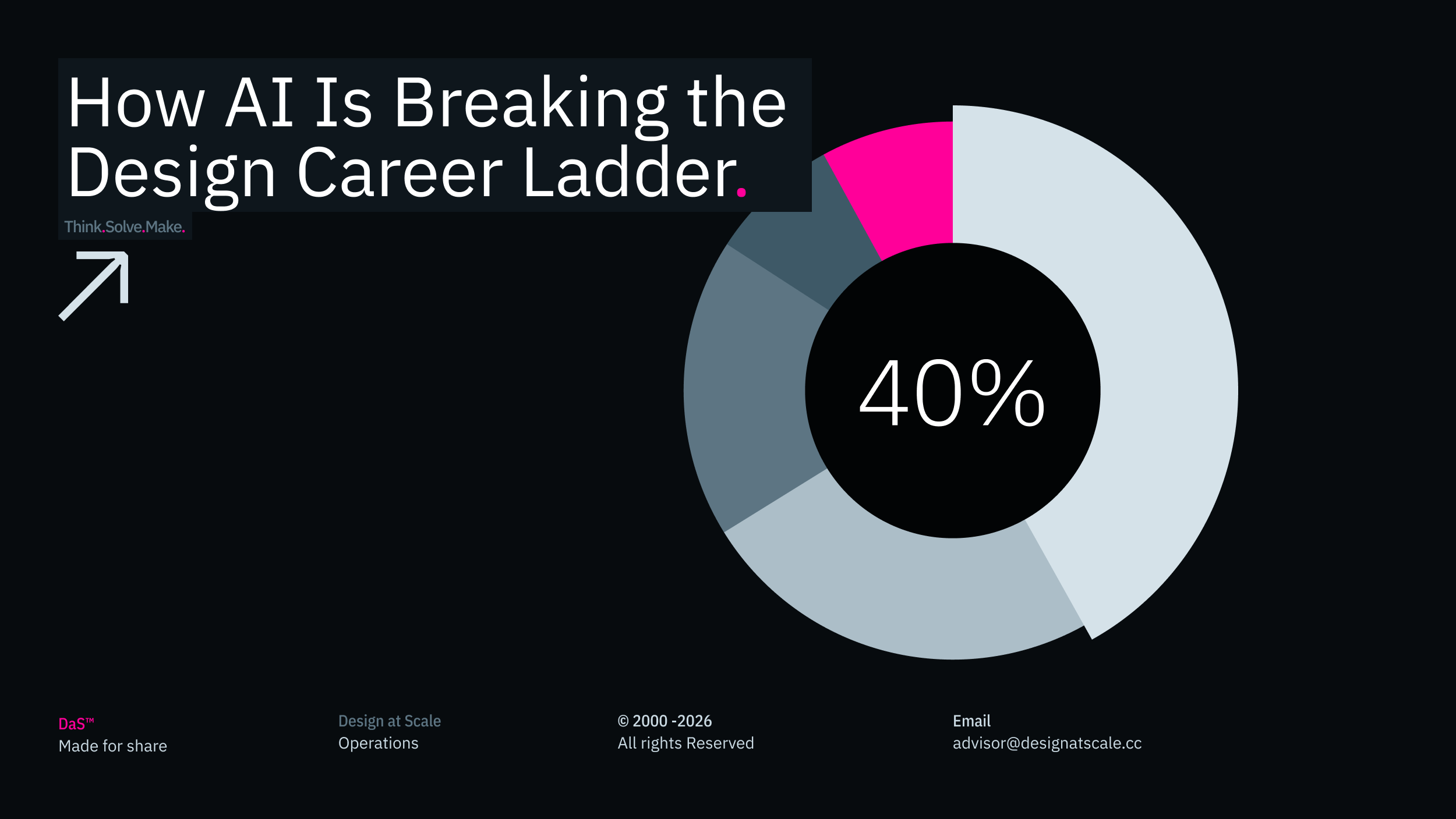
The structural risk isn’t theoretical. Research from the Massachusetts Institute of Technology, Northwestern University, and Yale published in 2025 found that when AI can perform most tasks for a specific role, the share of people in that role within a company falls by approximately 14%. The World Economic Forum’s Future of Jobs report projects that generative AI will disrupt 35% of workers’ core skills by 2030 — and that 40% of global employers expect to cut staff as those skills become less relevant.
— Source: Business Reporter 2025
What these figures fail to capture is the compounding effect on teams deprived of their foundational layers. Organisations that trim entry-level positions in pursuit of AI-driven efficiencies are, in effect, ensuring that in three to five years, there will be no one prepared to step into mid-level roles. Senior designers will find themselves burdened with workloads that ought to be shared, and the internal pipeline for promotion will have run dry. The inevitable recourse to consultants and external hires will prove far more costly than the junior salaries so assiduously trimmed.
There is a subtler consequence, the full extent of which is only now emerging in the data. The DEI commitments undertaken at scale between 2020 and 2022—diversity hiring pledges, expanded recruitment functions, broader candidate pipelines—were concentrated precisely in the entry-level and HR roles now first on the chopping block. The upshot is that the very populations these programmes sought to welcome into the profession are disproportionately affected by the cuts. To frame this as a mere efficiency narrative is to obscure the reality: the dismantling of the organisational infrastructure designed to broaden access to the profession, before that access had the opportunity to take root.
This is particularly pertinent to design, which faces its own iteration of the same dilemma. A mere 3% of design leaders mentor within their own organisations. Most mentoring occurs externally, leaving internal teams unsupported and disconnected from meaningful development. Remove the junior roles where such mentoring ought to commence, and the issue does not merely persist; it becomes structurally entrenched.
Design leaders who grasp the nature of this shift—and who act before the impending talent shortage becomes headline news—have three principal levers at their disposal.
The questions to mitigate such a transition can be found in the very core of the Design at Scale™ method, as we have been delivering transformation in automated (now Agentic) product design delivery for close to two decades.
Invest in internal mentoring before it becomes urgent. The DaS™ mentoring ethos is clear: mentoring without practice is mere opinion; mentoring grounded in evidence becomes leadership. Effective mentoring is measurable; it alters behaviour, broadens capability, and enhances outcomes. This rests on four foundations: a clear concept, a plan for success, a framework comprehensible to the mentor, and a structured approach to fostering others’ growth. None of this is prohibitively expensive, but all of it demands deliberate intent. The 3% figure is not an indictment of design leaders, but rather a reflection of how seldom internal mentoring is regarded as a core delivery responsibility rather than an act of goodwill.
Employ Show and Tell as a mechanism for knowledge transfer, rather than merely a delivery ritual. While Show and Tell reduces additional feedback by 35% and pre-release refactoring by 62%, its more profound function is cultural. It socialises design, normalises collaboration, and establishes the conditions in which less experienced practitioners can observe senior thinking in practice. A brief session in which a senior designer elucidates not only what they built, but why, is of greater value to a junior practitioner than a month spent working in isolation.
Prioritise Mobilisation before seeking Acceleration. The DaS™ scaling model is unequivocal: Mobilisation lays the groundwork, Optimisation refines it, and Acceleration is the natural consequence of both. Organisations that bypass Mobilisation—attempting to accelerate design capability by deploying AI tools without first establishing mechanisms for knowledge transfer, standards maintenance, and the integration of new practitioners—do not accelerate. They merely amplify disorder. The teams poised to deliver sustainable performance in five years are those investing in structure and knowledge transfer today, not those preoccupied with optimising headcount.
‘We do not have the budget to maintain junior roles if AI can perform those tasks.’ The pertinent question is not whether AI is capable, but whether the organisation can afford to forgo the individuals who will constitute its senior capability in four years’ time. The cost of a junior role today is markedly less than the expense of recruiting a senior external hire in three years, particularly in a market where experienced designers are scarce precisely because everyone reached the same conclusion.
‘Our senior designers can mentor informally; there is no need for structure.’ The evidence suggests otherwise. Only 3% of design leaders currently mentor internally. Informal mentoring is invariably the first casualty of delivery pressures; it occurs only when time permits, which is to say, infrequently. Structure is what ensures consistency. Organisations that treat mentoring as a delivery responsibility—embedded within the framework and measured like any other output—are those that sustain capability through periods of disruption.
‘AI will create new entry-level roles to replace those it eliminates.’ Perhaps, but not at the same pace, nor necessarily within the same organisations. The World Economic Forum projects a net global gain of some two million jobs as a result of AI-driven displacement, yet it remains silent on where these roles will emerge in terms of seniority, sector, or geography. For design teams making decisions today, the more candid assessment is that the career ladder, as previously conceived, is fractured in the middle, and no one yet knows what will supplant it. This very uncertainty underscores the importance of establishing internal mentoring infrastructure now.
The design profession now confronts a compounding dilemma. AI is eradicating the entry-level roles through which junior practitioners have traditionally developed. Internal mentoring, already chronically underutilised, loses its very foundation as these roles vanish. Organisations that cut most aggressively may realise short-term savings, but they are likely to encounter a capability drought for which they are ill-prepared.
The answer is not to resist AI, but to be intentional about what AI cannot achieve: the transfer of tacit knowledge, the modelling of sound design thinking in context, and the cultivation of the relational trust that transforms a novice into a confident practitioner. These are functions that demand proximity, structure, and purposeful leadership. They require mentoring to be regarded as a delivery responsibility, and the humility to acknowledge that the pipeline producing tomorrow’s senior designers is constructed from the junior roles now being eliminated.
The business case for what happens when this pipeline collapses — and what organisations can do before it does — is the territory Part Two explores. For more on building design capability that compounds rather than burns out, follow the series at designatscale.co.