Organisations trimming entry-level positions in pursuit of AI-driven efficiencies are engaging in a calculation that appears eminently rational when viewed through the lens of a spreadsheet, yet proves quietly ruinous over a five-year horizon. The savings are immediate and visible. The cost, however, slips in almost unnoticed: a dearth of senior capability that no one anticipated, in a market where every player has made precisely the same misjudgement.
The much-discussed talent drought is not some distant spectre. In the world of design, it is already under construction.
The rationale for dispensing with junior roles is, on the surface, unassailable: a task that once demanded five individuals can now be accomplished by one, aided by AI, in the space of an hour. The savings are tangible, easily demonstrated to any board. Yet what remains invisible to the spreadsheet is the value of what those five were actually doing beyond the immediate task: learning their craft, absorbing the subtleties of institutional knowledge, and developing the judgement that only years of experience can confer and which no algorithm can conjure on demand.
The prevailing assumption underpinning most AI-driven workforce decisions is that senior capability constitutes a stable resource. The notion persists that one can curtail intake at the entry level without disturbing the supply at the top; that seasoned designers, developers, and strategists will somehow continue to materialise in adequate numbers, irrespective of whether a structured pathway exists to produce them.
This assumption is mistaken, and those organisations slowest to recognise the error will find themselves paying the highest price to rectify it.
Design capability has, historically, been cultivated through a singular mechanism: proximity to those with greater expertise. The junior designer does not acquire mastery by poring over documentation. Rather, they learn by observing a senior practitioner reframe a problem, challenge a brief, or make a decision under pressure and articulate the reasoning behind it. It is this transfer of tacit knowledge—the sort that eludes style guides and digital repositories—that truly powers professional development.
Eliminate the junior roles, and the engine grinds to a halt. Not at once, of course; today’s senior designers remain in post. Yet within three to five years, the cohort that would have progressed to mid-level is conspicuously absent. The pipeline for senior positions has quietly evaporated. Organisations that assumed experienced talent would always be available will discover, all at once, that their peers made identical cuts and the market is uniformly depleted.
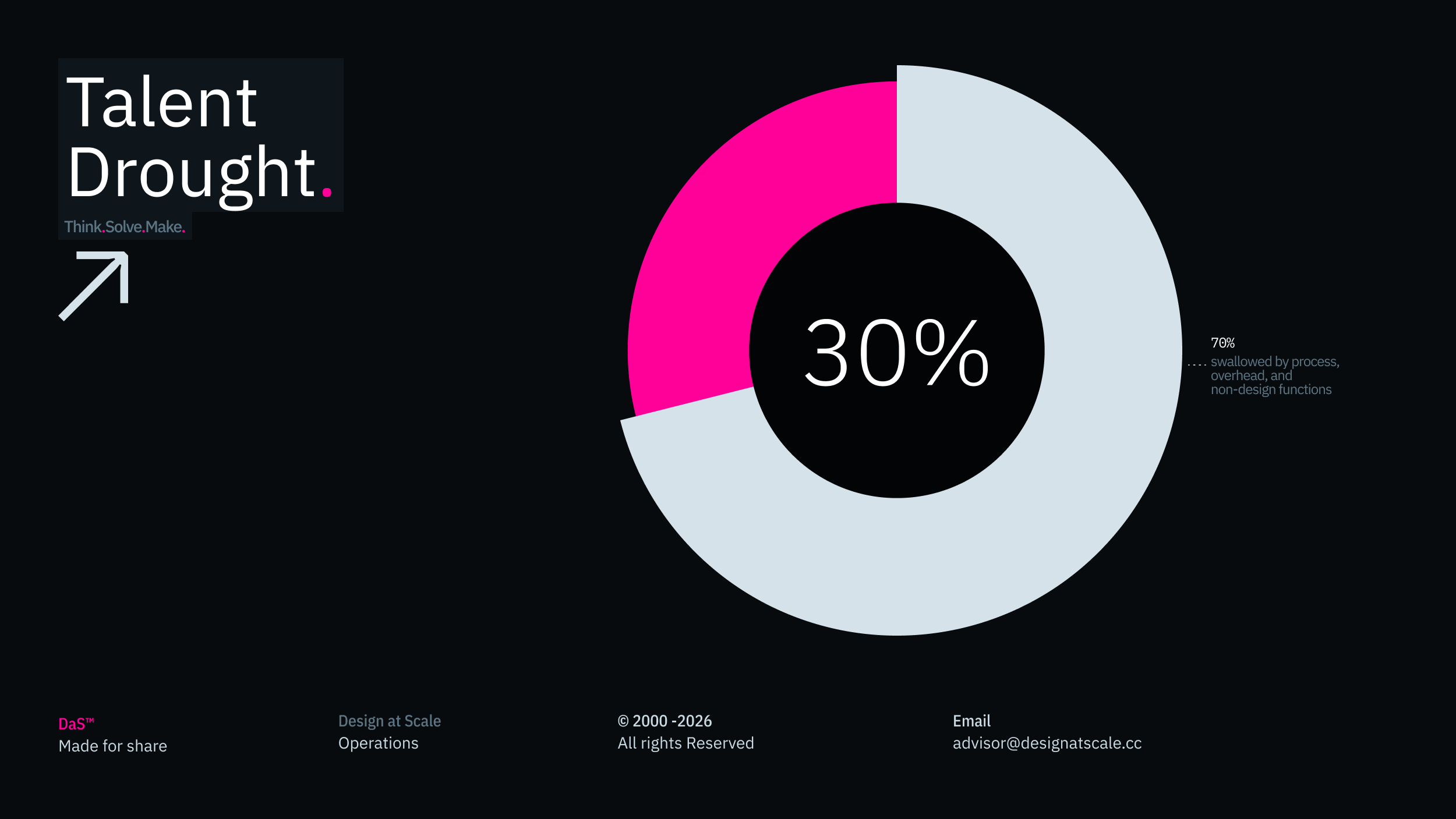
The figures render this reality unmistakable. Merely 30% of design work produced within agencies ever sees the light of day; the remaining 70% is swallowed by process, overhead, and non-design functions. Properly structured, self-managed teams can achieve 80 to 90% design-driven output from the outset. The gulf between these numbers is not a matter of innate talent, but of clarity, structure, and the cumulative wisdom of operational know-how. Such knowledge resides in people, passes through relationships, and rarely survives a cull of junior roles at the base of the organisational pyramid.
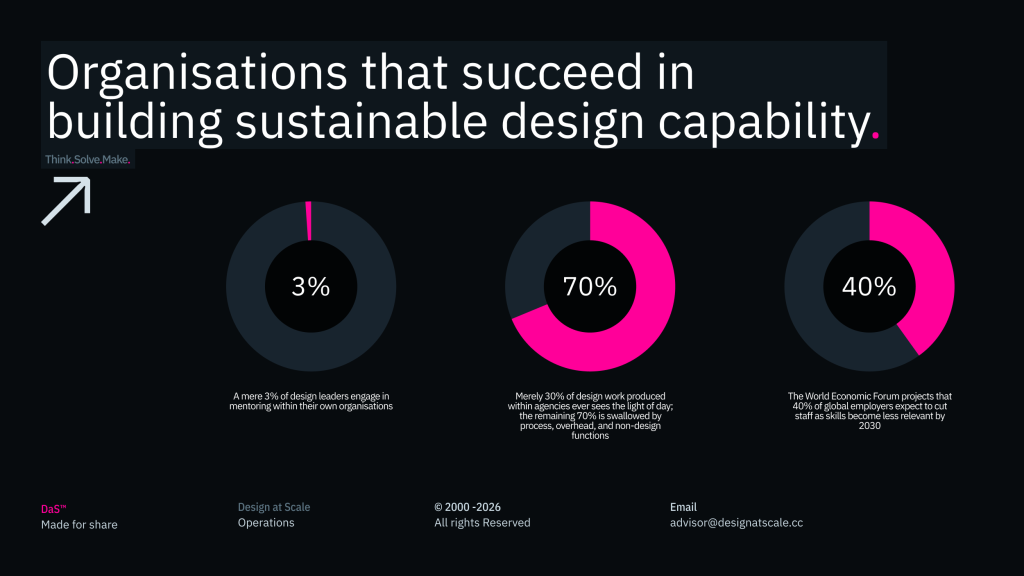
The World Economic Forum projects that 40% of global employers expect to cut staff as skills become less relevant by 2030. McKinsey estimates that 12 million people will need to switch occupations by the same year. The design profession sits inside both projections — and has an additional vulnerability that neither captures: the internal mentoring chain is already broken before the wider disruption arrives.
A mere 3% of design leaders engage in mentoring within their own organisations. Most knowledge transfer now occurs beyond the business—in communities, conferences, and informal networks that operate outside the formal team structure. Remove the junior roles where this transfer ought to commence, and the problem does not compound gradually; it accelerates at once, for the foundation was never robust in the first place.
Organisations that succeed in building sustainable design capability during this period share three defining characteristics, each of which is available to any design leader prepared to act before the shortage becomes painfully apparent.
Recruit for transformation, not mere transaction.
The DaS™ scaling model is unequivocal on this point: the essential decision is whether new hires address immediate tasks or contribute to enduring capability. Hiring for transactional needs is straightforward; hiring for lasting impact is a strategic endeavour. A junior designer whose remit includes structured mentoring, documented learning, and a defined progression path represents an investment in the team’s senior capability four years hence. A contractor engaged to deliver a sprint and depart adds nothing to that pipeline. Both incur costs; only one yields compound returns.
Regard knowledge retention as an integral part of delivery.
Designers can often identify the author of a file by its structure—the embedded decisions, the underlying system, the logic that binds it together. This institutional knowledge is the organisation’s most fragile asset, residing entirely in people and transmitted only through deliberate practice. DaS™ is clear: when everyone knows where information resides and how to access it, creativity becomes the sole variable. Poor documentation breeds delay, misunderstanding, and teams forced to rebuild from scratch each time someone departs. Organisations that enshrine knowledge retention—through documented decisions, shared foundations, and transparent delivery—are those whose capability endures disruption.
Establish the internal mentoring framework before urgency dictates its necessity.
Mentoring without practice devolves into mere opinion; mentoring grounded in evidence matures into leadership. The four pillars that render mentoring measurable—a clear concept, a plan for success, a framework comprehensible to the mentor, and a structured approach to fostering growth—are not inherently complex. They are, however, conspicuously absent from most design functions, largely because internal mentoring has seldom been regarded as a delivery responsibility. The moment to construct this framework is before the senior pipeline is exhausted, not in its aftermath.
‘We can always hire experienced designers externally when the need arises.’
Indeed, you can—though at a significantly higher cost, in a market where every organisation has made identical cuts and faces the same shortage. The externally recruited senior designer arrives bereft of institutional knowledge, context, and the relationships that underpin efficient delivery. Reconstructing what has been lost through attrition is invariably more expensive than maintaining it through foresight and structure. Prevention, as ever, is less costly than remedy.
‘AI will create new roles to replace those it eliminates.’
Perhaps—but not at the same pace, within the same organisations, or at the same career stage. The projected net global job gain from AI displacement is silent on where these roles will emerge in terms of seniority or sector. For design functions making decisions today, the more candid assessment is that the career ladder now has a broken rung in the middle, and no tool yet substitutes for what that rung once provided. Organisations waiting for perfect clarity before investing in internal development will, inevitably, have waited too long.
‘Our senior designers lack the time to mentor.’
Quite so—under current arrangements, where mentoring is informal, unscheduled, and regarded as an optional extra rather than an integral part of delivery. The answer is not to conjure more time, but to embed mentoring within the delivery framework, ensuring it emerges as a natural outcome of the work rather than a discretionary act of goodwill. Show and Tell, the step most frequently omitted in design delivery, reduces additional feedback by 35% and pre-release refactoring by 62%. Its less visible benefit is equally significant: it places senior thinking in context before the entire team, every sprint. That is mentoring at scale, and it requires only a fifteen-minute commitment.
The talent drought currently in the making will not herald its arrival in advance; when it does, those organisations that have cut most deeply will find themselves vying for senior capability in a market afflicted by the same shortage, paying external rates for knowledge they might have preserved internally, and reconstructing pipelines that required years to establish.
Scalability is not a function of headcount. It derives from clarity—in structure, in knowledge transfer, and in the deliberate cultivation of those who will form the organisation’s senior capability in four years’ time. Integrated, motivated teams with sound foundations deliver at three to five times the pace, with no additional effort. That is the dividend of investing in the pipeline now. The alternative is the belated realisation that efficiencies gained at the base of the organisational chart exact a far greater cost at the summit.
The design profession possesses the frameworks, methodologies, and evidence required to build capability that compounds rather than diminishes. The real question is whether design leaders will employ them before the impending shortage compels the discussion. For further insights on constructing design teams that scale sustainably, visit designatscale.co.