;

Design at Scale – Mindset

Featured Image

Welcome to Design at Scale – this article will focus on the mindset and how adopting it can make a difference in Product Design Delivery. To understand the mindset definition, let’s borrow the description from the encyclopaedia:

In “the decision theory” and general systems theory, a mindset is a set of assumptions, methods, or notions held by one or more people or groups of people.[001]

On the other hand, a design mindset utilises the assumption around the concept that reflects the holistic answer to a specific problem under common understanding and well-communicated outputs (reflecting monetary/business purpose) to achieve desired outcomes.

These mindsets build around professions. Historically, companies created teams and later departments. Departments that hold the functions are inevitably risk reversed [002]. Protecting knowledge is the mindset where only the department has the expertise and can execute it. The design department is responsible for all design in the company. The accounting department is responsible for the salaries. 

“New eras require a new mindset,
the mindset of scale.“
– Jiri Mcc, Greenwich, London, 2015

A challenge mindset creates a well-diverse product team where several disciplines collaborate on one specific outcome. Insight teams protect what they find. Researchers test what they think is essential for the imaginary user. Designers design what they believe is right, and developers build what they can and could work on in the next 3-6 months. Otherwise, no one from the above gets paid in the end – fun aside.
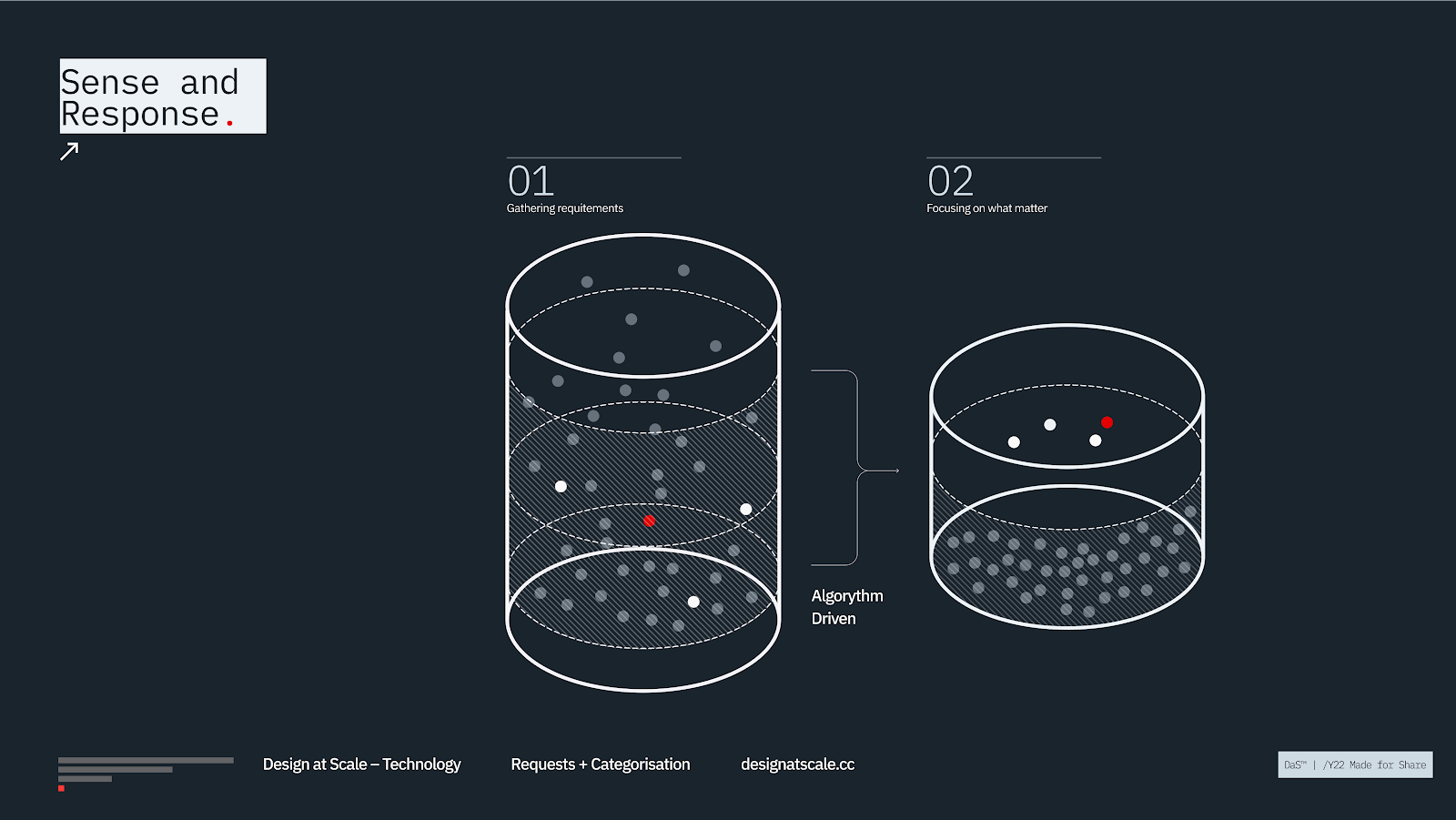
Figure 02: Knowledge base

Is there a different way?

Of course, there is always a better way. Whether you are using methods like opportunity management[003], Stage and Gate[004] or Phase gate[005], the most significant impact on the team and the delivery is transparency. Deciding to create a “knowledgebase” would be the most thoughtful way to capture, manage and distribute the knowledge within and outside the team. This allows all participants to create the “baseline” for making self-organised and well-collective decisions without extra effort and waste chatter on communication software[006] [007] or another medium.

Mindset

A DaS™ mindset – can be seen as 
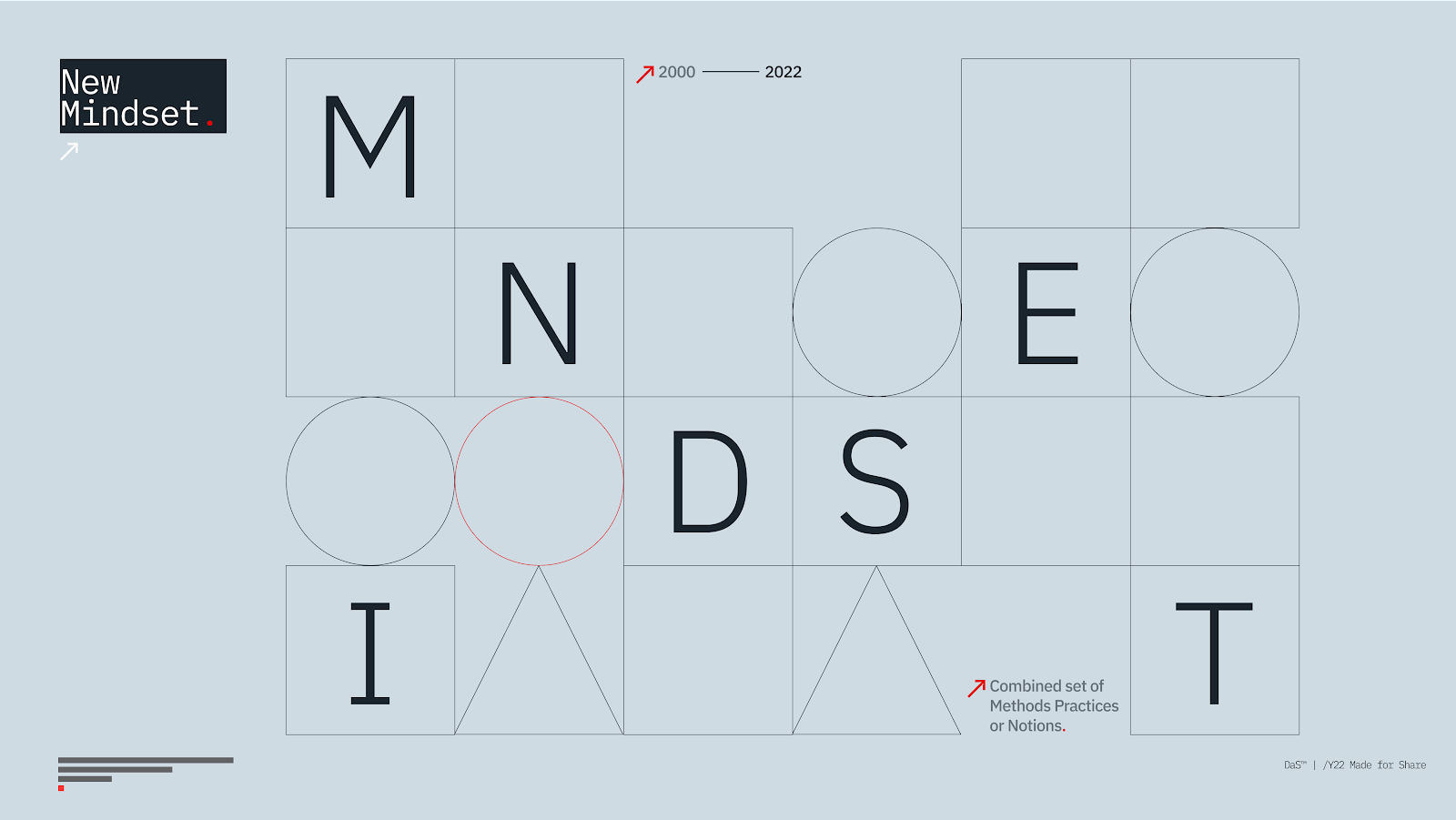
Figure03: Quote

A person's unique perspective or philosophy of project delivery allowing these individuals to act (thought process involving understanding, collaborating, learning, and staying flexible) to achieve high-performing results on a specific task, decision or outcome necessary to deliver an incremental value to the team and the customer. 

This mindset guides the team members and allows them to collectively adapt to change rather than struggle individually or in silos[008]. It prevents chatter and the loss of valuable information by focusing on clarity throughout the process. 

Initially, this could sound rigid or hard to digest, and of course, there is a transition period for the team. Eventually, the team even make it or breaks it. Those who make it work less and more efficiently; those who don’t will complain about how “busy they are”. 

Figure04: The most expensive words in business:
“We have always done it this way.”

Happy scaling through design!

Hey, I’m Jiri Mocicka.
London-based Product Design Director, Trusted Advisor and Author of Design at Scale™. The method that empowers individuals to shape the future organisation through design.
If you have a question, join our Community and reach out to like-minded individuals who scale design propositions. An online Academy can help you to define teams of 01, 10, and 100, and 1% supported by Grid Magazine and Supply section, where we bring more insights weekly on how to become a design leader in your Agentic Organisation

Author's Name

AVATAR

inResearch

42

inWriting

70

Released

235
EMT

Related.

Featured Image
In 1945, Kiichiro Toyoda set his company a challenge: Catch up to America. At the time, Japan had few resources and even fewer machines. …
February 26, 2025
 · 
3 min read
Featured Image
It’s a common misconception that Henry Ford invented the automobile.The reality is, he didn’t. What he did invent was scale, however.  Ford’s true genius …
February 19, 2025
 · 
3 min read
Featured Image
If we want to understand where design is heading, we need to remember where it came from. Historically, design was a sequence: sketch, refine, …
February 12, 2025
 · 
2 min read
Featured Image
In early 2026, we all saw some experiments and prototypes in which one node connected to another could transform an image into a series …
January 6, 2026
 · 
6 min read
Featured Image
In the early 1900s, a cobbler knew every curve and stitch of the shoe they made. They built by hand, understood materials intimately, and …
January 22, 2025
 · 
3 min read
Featured Image
Since the early 2000s, the demand for designers has surged. As technology moved fully into digital, designers were forced to evolve with it. We …
January 8, 2025
 · 
3 min read
Featured Image
Not every generation of designers is made equal. The Bauhaus movement, born in the political tension of interwar Europe, gave us the first modern …
January 15, 2025
 · 
3 min read
Featured Image
Most designers spend 80% of their time promoting their skills and only 20% sharpening them. It’s as if we’re all waiting for a design …
February 5, 2025
 · 
3 min read
Featured Image
Design has never stood still. Over the past century, it has transformed again and again. Each shift in form or function reflects a deeper …
January 1, 2025
 · 
4 min read

GRID Magazine

Explore OUR 
Articles

Every week we bring set of stories reflecting on communication, operation and technology.

Newsletter

Subscribe.

We share our 20 years of experience in creating, managing and scaling products and services that allow individuals to shape organisations through design.

Design at Scale™

LINE_MAGENTA_050_301

Categories

LINE_MAGENTA_050_301

Data

LINE_MAGENTA_050_301

Share

Internal

Collaborate

Resources

IBM PlexSan
Regular
Charcoal

Design at Scale™ is defined by three models, which form the Method. Each model operates in a different part of the business and collects and informs parties on design and engineering decisions that have a direct impact on the delivery.

All brands and trademarks presented on the Design at Scale™ website are owned by their relevant companies or agencies. The projects represent collaborations between designers, developers and product owners. Do not copy or publish any of the projects shown here without written approval from Design at Scale™ (alternatively GIVE™, 9V™) and/or relevant companies and agencies.

SOC_Twitter
SON_LinkedIn
SON_Instagram
SOC_-Medium
View