
Design teams are often distributed across continents, but the more significant challenge is their distribution across multiple propositions within a single product ecosystem. Designers jump between onboarding, account settings, basket, booking, player journeys, and dozens of micro-features - all competing for attention. Meanwhile, they face requests such as “Can we present this tomorrow?” without receiving essential context about underlying technology, data structures, or system constraints.
Under this pressure, product knowledge erodes. Design becomes reduced to copy-and-paste from the Digital Design Library (DDL), detached from variables, customised to satisfy a single stakeholder, and stripped of broader intent.
Challenge 1: The Illusion That Design Systems Replace Designers
Poorly maintained design libraries give organisations the false impression that designers are no longer required. Designers are pushed into product roles, leaving the design system under-invested, outdated, and disconnected from business needs.
Fast delivery does not come from handing work over quickly. It comes from empowering designers to make design-led decisions. The highest-performing model moves experienced designers into a centralised Design System Team, allowing knowledge to be both preserved and distributed.
Challenge 2: “Designing What No One Wants”
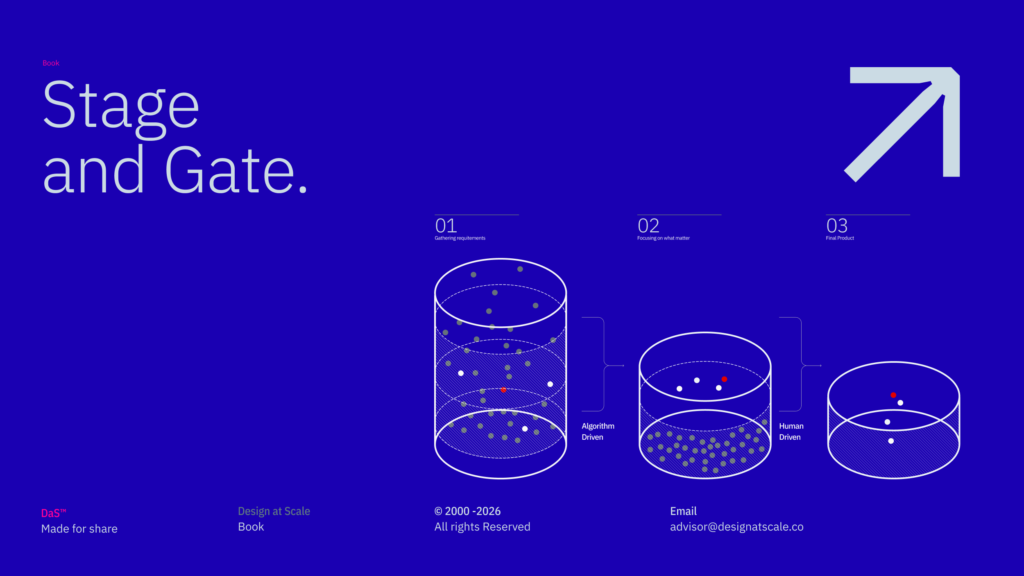
Design teams are often blamed for producing work “no one asked for,” when in reality they lack visibility. Many agencies supporting in-house product teams work through three to five intermediaries before a design reaches engineering. If each intermediary conveys only half the information, the designer receives roughly 3% of what matters.
DaS™ resolves this by defining transparent gates where work is validated, documented, and shared directly with engineering. Noise is reduced. Alignment increases. Designers operate with clarity rather than inherited assumptions.
Agile provides the rails; DaS™ ensures designers can drive on them effectively - achieving consistency, standardisation, and a clear flow of design into development without unnecessary filtering.




