The most common interview opener is also the most commonly botched. Not because candidates lack a wealth of experience or confidence, but because they fundamentally misunderstand what is being asked of them. Master this moment, and you set the tone for the entire interview. Miss it, and you spend the rest of the hour trying to recover lost ground.
"Tell Me About Yourself" — is not really the question we ask.
Most candidates, when asked "Tell me about yourself," treat it as an invitation to narrate their life. Where they grew up. Which university they attended. Their first job. That year they spent abroad. The hobbies that make them a rounded person. It feels natural — the question uses the word yourself, after all.
But here is the mistake: recruiters are not conducting a biography session. They have a limited time window, a shortlist of candidates, and a specific problem to solve. They do not need your autobiography. They need to know — quickly and clearly — whether you can do the job.
Worse, the life-story response signals something a recruiter does not want to see: a candidate who cannot read the room, cannot self-edit, and cannot connect their experience to what is relevant. Picture the scene — a recruiter who has already sat through three candidates that morning, each starting with their degree, a job from a decade ago, and a digression into personal interests. By the time candidate four walks in, their attention is already threadbare. The glazed expression, the glance at the clock — you are losing them before you have said anything that matters.
Here is what "Tell me about yourself" is actually asking: Can you clearly communicate your professional value, and does that value align with what we need?
It is a test of self-awareness, relevance, and communication skill — all rolled into one deceptively casual prompt.
Think of it as the opening paragraph of your cover letter, delivered aloud. A strong cover letter does not recap your life chronologically; it connects your experience directly to the role. The same principle applies here. If you studied the job specification before applying — the language used, the qualities described, the skills listed — then your answer to this question is built from that material. Mirror their language. If the spec says "cross-functional collaboration," do not say "I work well with others." Use their words. Show them you have read what they wrote and understood what they need.
A recruiter also has a secondary purpose when asking this question: to see whether your CV is an honest reflection of you. Anyone can list skills on a page. The interview opening is where candidates either confirm their competence or quietly begin to lose credibility. Walk in with a clear, confident, relevant opening, and you have already started demonstrating what they are looking for — before they have asked a single technical question.
The candidate who opens with their current role, names a specific achievement from the past twelve months, and connects it cleanly to the job in front of them. The recruiter often leans forward, listens intently, and pays attention to transitions between topics. The conversation begins in the right place, in the right mind, and it simply clicks. That is the difference preparation makes.
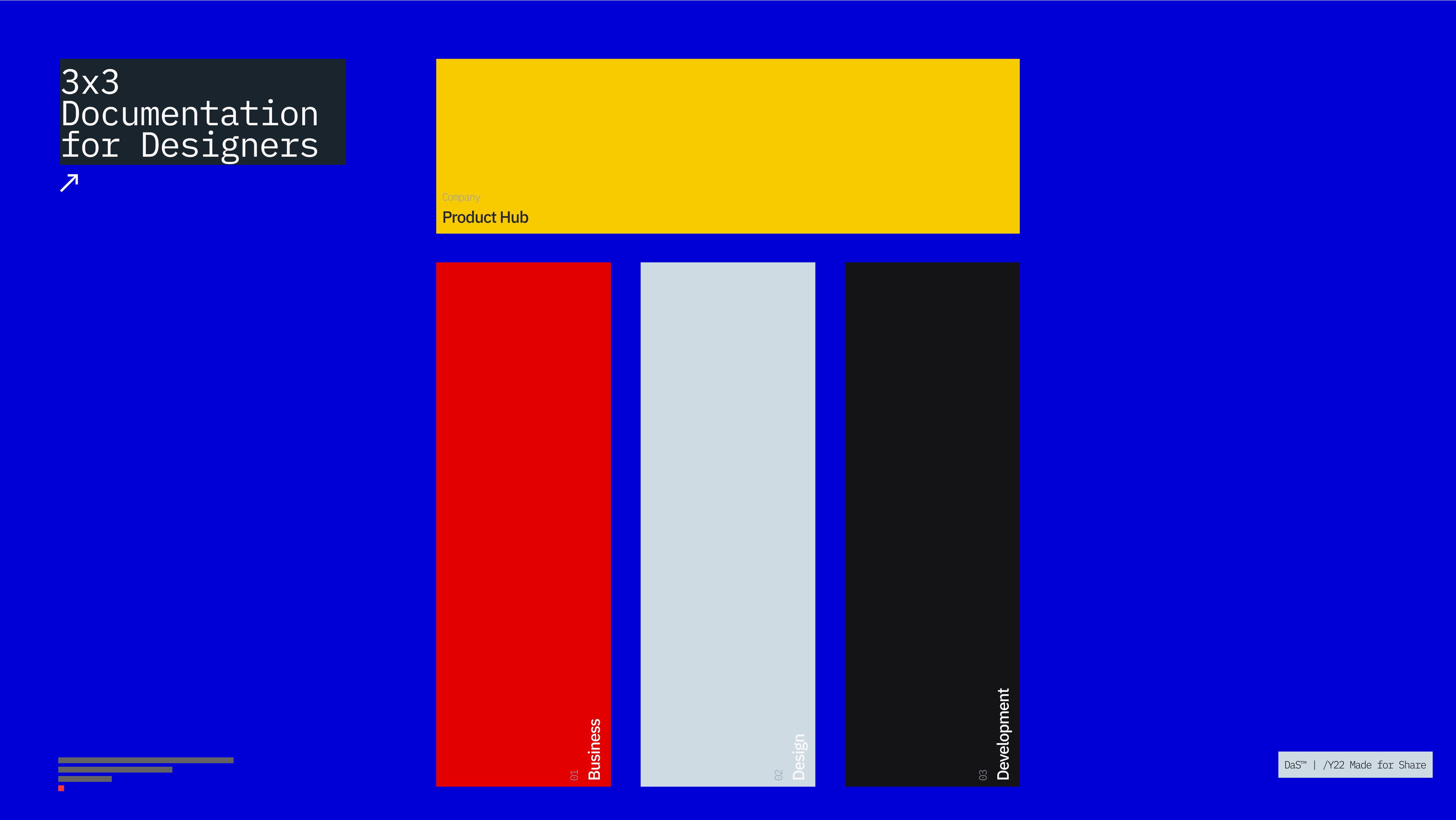
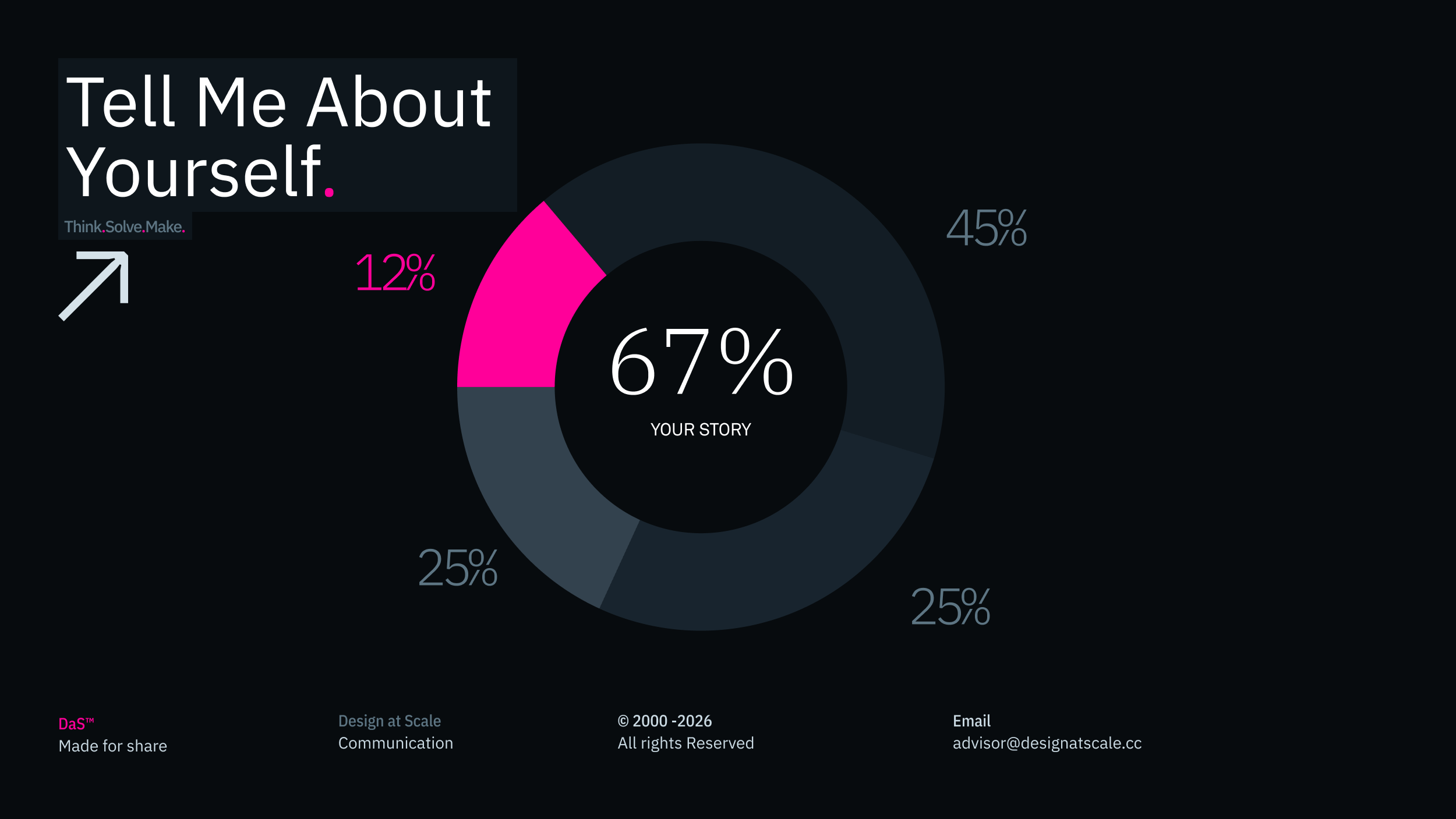
Preparation is everything, and the best preparation is structured. Rather than trying to summarise your entire career, organise your achievements into four distinct lenses before the interview. This gives your answer shape, substance, and range — and it prevents you from defaulting to a single dimension of your experience.
Business achievements — What impact have you had on commercial or organisational outcomes? Think revenue influenced, costs reduced, efficiency improved, or processes transformed. These do not have to be enormous numbers, but they must be real and specific. "I contributed to a product launch that reduced customer onboarding time by 30%" is far more compelling than "I have a strong business mindset." Recruiters in product roles want to know you understand that design and development exist to move the business forward — not just to produce beautiful work.
Design achievements — What have you shipped that you are genuinely proud of? Where did your design thinking change the direction of a product or meaningfully improve the user experience? This is where your portfolio speaks, but your words frame it. Name the problem, describe your role in solving it, and — critically — articulate the outcome. Design achievements should demonstrate both craft and consequence.
Engineering achievements — You do not need to be an engineer to have engineering achievements, but you do need to have worked alongside them in a way that moved things forward. Did you help bridge a communication gap between design and development? Did you contribute to a technical decision that improved delivery? Did you reduce rework by improving the quality of handoffs? In product design and development roles, the ability to operate fluently alongside engineering teams is not optional — it is a differentiator.
Significant collaborations — Some of your most important professional achievements will not belong to you alone. Name the cross-functional work: the stakeholder you brought onside, the product manager you partnered with to reframe a brief, the research initiative that aligned three departments around a single insight. Collaboration is not soft — it is the mechanism through which complex work gets done. Demonstrate that you understand this.
You do not need to cover all four in your opening answer. Choose the one or two most relevant to the role in front of you, and let the others surface naturally as the conversation develops. End your answer by signalling where you are heading — why this role is the right next step — and leave the recruiter with a thread to pull.
The candidates who perform best in interviews are not the most naturally confident — they are the most prepared. And preparation, in this context, means doing the work before you walk into the room, not improvising your way through it.
Check, do not assume. Before your interview, revisit the job specification in detail.
What language does the company use?
What problems are they actually trying to solve?
What does the team structure look like, and where does this role sit within it?
Do not assume you know — verify. Read their recent case studies, look at what the team has shipped, review public commentary from people who have worked there. The more precisely you understand what they need, the more precisely you can demonstrate that you provide it.
Know who you are meeting. If you have been given names ahead of the interview, look them up.
What is their background?
What have they built or written or spoken about?
This is not about flattery — it is about context. A recruiter who has spent ten years in engineering will respond to different signals than one who has come from a research background. Adjust accordingly.
Prepare questions, not just answers. "Tell me about yourself" opens the conversation, but the candidates who leave a strong impression are those who arrive with genuine curiosity about the role, the team, and the challenges ahead. Prepare two or three specific questions — not generic ones — that demonstrate you have done your research and are thinking seriously about the opportunity.
Double-check the details. Confirm the time, the format, the location or link. Know whether it is a panel or a one-to-one. Find out how long you have been allocated. These are not administrative trivialities — they shape how you pace your answers and manage your energy in the room. Arriving uncertain about the basics costs you composure before you have begun.
The candidates who stand out are not the ones who reacted best on the day. They are the ones who prepared most thoroughly beforehand.
"Tell me about yourself" is the opening move of every interview. Get it right, and you set the tone for everything that follows — the recruiter is engaged, the conversation finds its natural rhythm, and you have already begun demonstrating the skills they are assessing. Get it wrong, and you are recovering from the first minute onwards.
Connecting the dots – organise your story around what you have delivered: business impact, design outcomes, engineering collaboration, and the partnerships that made complex work possible. Leave the recruiter with something to explore. And do all of this before you walk into the room — because the best answers are not improvised. They are built.
At Design at Scale™ Academy, we believe that clarity is a professional skill — one that shapes how careers are built just as much as how organisations operate. If you want to think differently about how communication, preparation, and self-awareness drive real results, the conversation meets us at designatscale.com.