The Retainer Is Not Dead — What Should You Do Instead?
The agency retainer was one of the most elegant commercial inventions of the twentieth century. A client pays a fixed monthly fee; the provider reserves capacity, delivers work, and maintains the relationship. Everyone knows where they stand. Invoices go out on the first of the month. The model held for decades because it rested on a stable premise: the client needed you to do the work because they couldn't do it themselves.
That premise is dissolving faster than most providers are willing to admit.
Strip the retainer back to its foundations, and three things were always bundled inside it: access to tools, access to skill, and access to time. The client paid for all three because they lacked all three. A small business owner couldn't afford design software, couldn't hire a senior designer full-time, and didn't have hours to spend learning a craft they'd never need at scale.
AI has unbundled that package. Tools are now accessible to anyone with a browser and a paid subscription. Skill — at least at the level of early-stage execution — is increasingly available through a well-structured prompt. Time compression is so dramatic that what once took a designer a day can take a client an afternoon.
The client isn't paying for three things anymore. In many cases, they're paying for one — and they're not always sure which one. The instinctive response from providers is defensiveness: a reflexive insistence that "you still need me for this." That posture frames the client's growing capability as a threat to be managed rather than a signal to be understood. It serves no one — and it delays a more urgent, more honest conversation about what the retainer should actually be selling.
The operational problem is this: the retainer was built on a direct correlation between time and value. More hours meant more work. More work meant more value. The invoice reflected the effort, and the effort was visible.
That correlation is broken. A provider can now deliver more value in fewer hours than ever before — not because they're working faster, but because the tools available to them are exponentially more capable. Paradoxically, this makes the retainer harder to justify, not easier. When a client can see that output that once took 10 hours might now take them 2 hours with an AI tool, the question of what they're actually paying for becomes unavoidable.
The delivery model is equally stressed. The traditional agency workflow ran left to right: discovery, strategy, design, production, handoff. The client sat at the beginning and end. The provider owned the middle. AI has compressed that middle. Early-stage execution — layout generation, initial prototyping, copy drafts, proof-of-concept builds — is now within reach of a capable, curious client. Not perfectly. Not production-ready. But well enough to form a starting point.
What remains — and what stays genuinely beyond most clients — sits at the boundaries. At the front: the coherent brand foundation, the structured design system, the tokenised library, and the documented decision-making framework that gives any AI-generated output something meaningful to draw from. Without this, client self-service results in inconsistent speeds. At the back: accessibility compliance, integration with live systems, deployment governance, performance under real conditions, and the legal and operational considerations that no prompt can navigate on a client's behalf.
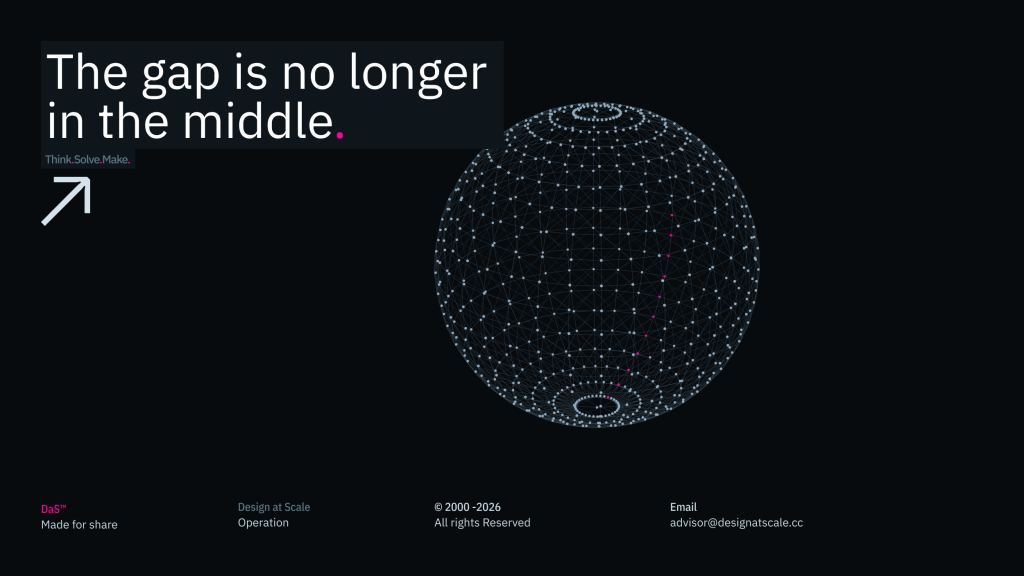
The delivery gap is no longer in the middle. It's at the edges. And the retainer hasn't moved with it.
What the retainer needs is a new organising principle — and the Power of One offers exactly that. Before Design at Scale™ existed as a methodology, its precursor was a four-part proposition built around measurable goals and design integration: One Language, One Space, One Team, One Product. Originally developed to align design within agile delivery cycles, these four principles translate directly into a retainer structure well-suited to the AI era.
One Language reframes what providers are actually selling. Not execution — translation. The client who builds their own website with AI assistance still needs someone who can reduce technical risk to terms they can act on: where a self-built form will attract spam, what DNS configuration means in practice, and why accessibility compliance matters before the site goes live. One Language means the provider's value is in making complexity navigable — a shared vocabulary between expert and client that makes every decision better informed.
One Space solves the operational fragmentation that AI-enabled self-service accelerates. When a client experiments in one tool, stores assets in another, and deploys from a third, each iteration is a dead end. One Space means everything lives in a single, connected environment — design files, documentation, component libraries, decision records — so that each experiment the client runs builds on the last, rather than starting from zero. The retainer maintains that space. Without it, client capability compounds disorder rather than value.
One Team redefines the relationship structure. The retainer that survives isn't a vendor arrangement — it's a partnership between two businesses. Provider responsibility and client capability are explicit, not assumed. The client knows what they own. The provider knows where their involvement begins and ends. This isn't a weakening of the relationship; it's a clarification that makes it more durable. A client who understands exactly what their provider does — and what they'd have to absorb without them — is a client who renews.
One Product keeps the commercial agreement anchored to outcomes, not outputs. The retainer isn't a bucket of hours; it's a commitment to a coherent, maintained, deployment-ready product foundation. The question it answers isn't "how many screens did we deliver this month?" but "is the product more coherent, more capable, and more safe than it was last month?" That's a question a client can answer — and a provider can price for honestly.
"If I make the client more capable, they'll need me less."
The opposite is consistently true. A client with a coherent design system, a documented decision framework, and a well-structured One Space runs more experiments, moves faster, and encounters more situations that require expert judgement — not fewer. Capability expands the surface area of the relationship; it doesn't reduce it.
"Outcome-based retainers are harder to scope and price."
They are. They're also harder to cancel. An hourly retainer is terminated when the client decides the hours aren't worth the invoice amount. An outcome-based retainer is terminated when the system it maintains begins to break down, which is a much higher bar. The short-term discomfort of renegotiating the commercial structure is considerably lower than the long-term risk of defending an invoice the client no longer believes in.
"Our clients aren't using AI yet — this isn't urgent."
The clients who aren't using AI tools today are watching the ones who are. Adoption doesn't announce itself in advance. It arrives as a cancelled renewal, along with a polite explanation that "things have changed." The providers who redesign their retainer now, before the conversation is forced, are the ones who shape the new terms. Those who wait will respond to them.
The retainer model that survives the next five years won't be the one that defends its hours. It will be the one that redesigns its value proposition around what AI cannot do: strategic coherence, system integrity, a shared language between expert and client, and a single connected space where everything the client builds is safe to build on.
One Language. One Space. One Team. One Product. These aren't abstract principles — they're the four structural gaps the AI era has opened in the agency retainer. Providers who close those gaps will find the relationship stronger, not weaker. Clients who gain genuine capability inside a well-maintained system don't need less expert involvement. They need different expert involvement — and they're willing to pay for the version that's honest about what it is.
If you're rethinking how your practice delivers value, once clients can self-serve the easy parts, the conversation continues in Part Two, where we look at what a retainer built around system maturity, Definition of Ready, and composable design skills actually looks like in practice. Visit designatscale.co to follow the series.