In early 2026, we all saw some experiments and prototypes in which one node connected to another could transform an image into a series of retail-ready image collections. Where the Cursor can, with an elementary definition of the product, allow you to shape your product in real code with no or minimal coding knowledge, and how Base44 or Lovable can make a simple web from a one-line prompt.
If that makes you sleepless at night, you haven’t experienced a nightmare yet. This article is not here to scare, but to shape the perspective of the possible future and decide where you will belong as a designer. Regrettably, access to new tools has led to a shift in human perception: everyone is a creator, and everyone has a right to create.
Good News: Everyone is a designer!
Bad News: Everyone is the designer?
This isn’t about restricting creativity or banning people from using creative software with some automation. It is about the knowledge we pass from generation to generation about quality, detail, beauty, and, in many respects, luxury, which perceives quality and value. Regrettably, over the last two decades, we're seeing less and less of it. Poorly designed signs, navigation, interaction patterns, navigation model, and sometimes behaviours that lock us into being unable to finish the task in question. Now, even further, we have an AI assistant on the side, wasting more time and further testing our patience.
The question arises: are we missing senior staff in principal positions that reshape the systems and processes of companies that have a direct impact on how society operates? I refer to the paradigm of knowledge as the most profound identifier of a mature society, regardless of regime, religion, and climate. One would believe that a mature society is more likely to have a company that reflects these values in its structures.
Designing with an AI
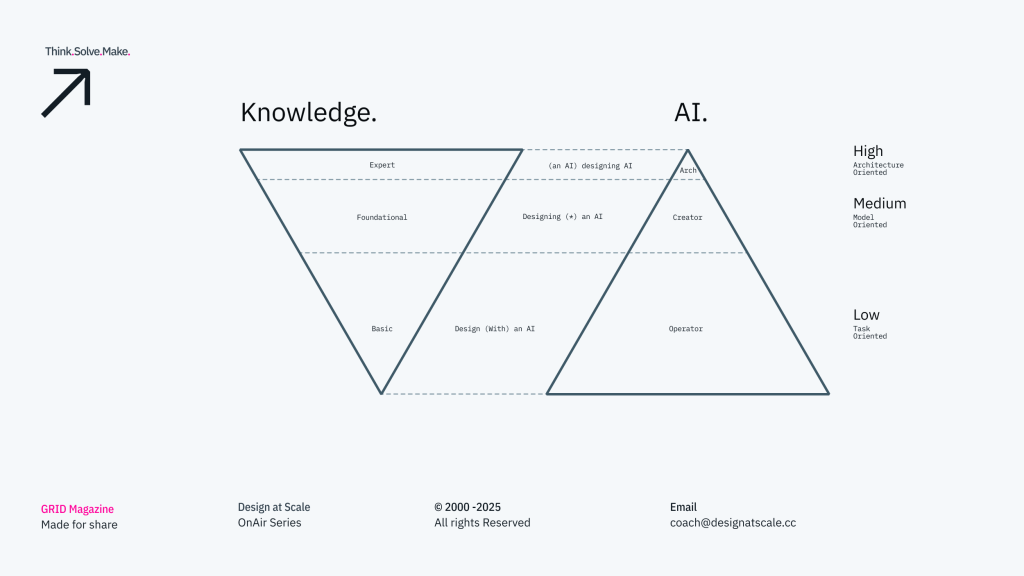
The picture above situates a paradigm that you can see daily in the media. News reports often proclaim that an AI can do one task 10 times faster than a human. Leaving aside the fact that the operator needs to set up the data feed, select appropriate models, and arguably give the right prompt. Not to mention having the knowledge to decide what is or is not a valid output that drives desired business outcomes.
This way, we have now built slightly more sophisticated workforce operators that can perform our tasks more efficiently. Therefore, this and next year our organisation can do the same thing 3-5x faster. Arguably, this is not even innovation; it's a natural progression in which knowledge takes the form of manuals and becomes guides and prompts that we often download as a spreadsheet on LinkedIn. This is now 90% of the design market today. Prompt definition, prompt request, prompt adjustment, prompt hallucination and prompt with a semi-decent outcome, and prompt to get something that can be used or developed further. Or you can just prompt copy-and-paste and fund design and product briefs with traces of ChatGPT in the client deliverables.
Designing for an AI
Very few companies in this example agencies have now stepped back and realised that they are already sitting on 20-30 years of customer or creative data that can be reused to train these new agents, allowing agencies to have their version of a creative companion with a specific signature that can reshape any trend and client in seconds. It also gives us a competitive advantage by leveraging all the unpublished or discarded versions that still sit on agencies' hard drives. The knowledge that shaped a creative industry with a specific signature of AKQA, W+K, Huge, R/GA, BBH, Mother, and BBD, to mention just a few. This way, next time as a client, you should request not one or two brand variations, but 6 different vibe-coded propositions with customer validation that already represent your use case and address a very specific problem of your organisation. Not to mention, there should be an operational and integration manual on GitHub, so your engineering team can validate, integrate and test it in their test environment. If that’s not the case, the question is what you are really paying for?
Designing AI
At this point, you may not know how to sell the shoes through Shopify or how to build a single business performance overview in your organisation. And heck, let’s not stop there, the application should monitor and augment to optimise all inefficiencies across the end-to-end delivery process, starting from proposition shaping through design, prototype, build, test integration and measurement of the impact.
I’m thinking a dashboard that connects cca 70-160 internal applications that collect data from your Word Document, Excel Sheet, PowerPoint, PiD, HLR, compare with UAC and read every line of the code before you hit the SEND to your virtual profiled customer agent that will operate a series of tasks before it’s released tothe internal framework.
You say it's impossible; last week, I watched a Google experiment in India that already shows a proposition currently monitoring: 30 applications, including Slack, Asana, Jira Management, GitHub, Zoom, Otter, and Office 365, that identify and suggest optimisation and team performance in real time.
AI designing AI
This space is unclear to me. Simply because I’m not a mathematician nor an engineer, despite my admiration and interest in this subject. It caught my attention that designing an AI model is very similar to how Design at Scale™ addresses the complex design proposition. Our five pillars are almost identical to the five stages of the AI Module's development.
We deal with proposition shaping (understanding), design shaping (defining experience), refinement(validation), development, and integration (deployment). Building an AI model involves data preparation (understanding), training (defining the experience), validation (data science), fine-tuning (operator testing), and final deployment (integration).
In the past, models had to be built from scratch; this is no longer the case, as the foundational model takes over and can be trained on a different set of data to achieve different or combined outputs. This is a fundamental shift in understanding the scale that will happen to our design industry. As you can see, the process that we humans develop is quite similar to how we behave, not necessarily how we can implement our organisational behaviour.
Knowledge
The bottom line here is not the speed at which we make progress, but the quality of agents with associated services we can provide to the business we operate in. And yes, the top of the iceberg is the knowledge that needs to be acquired, not necessarily by testing one thing over and over; it is about studying and clarifying the business trajectory of the continuous development that will be relevant in 10 years from now. Curiosity will take you as far as the operator; the knowledge will take you all the way to the top.
Summary
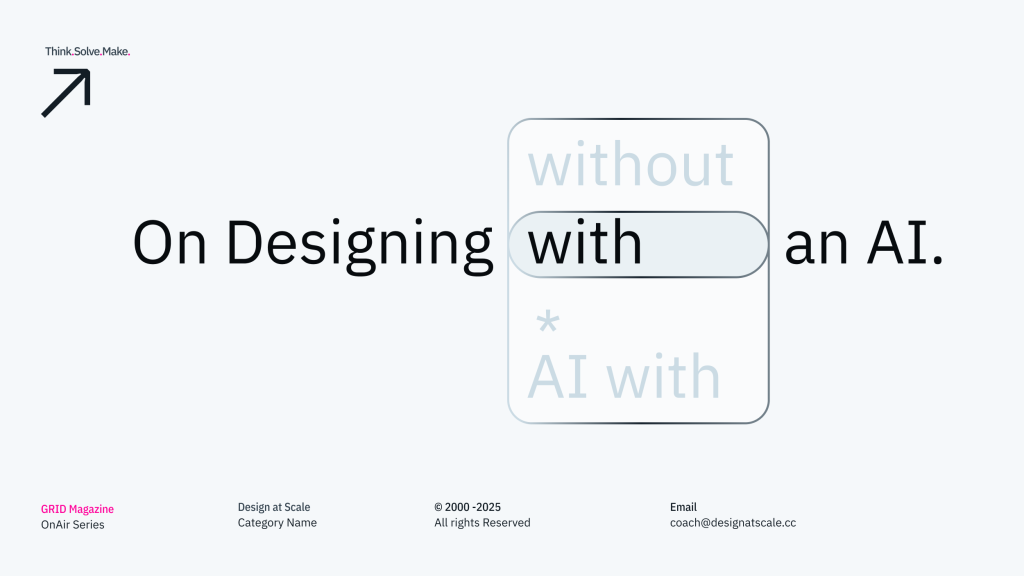
This article combines a paradigm of knowledge in reflection of designing “without”, “with”, and “for” an AI. It touches on data quality, automation, and operational excellence. While simultaneously reflecting on human capabilities and the necessity of making informed decisions, not only based on provided information, but mostly on critical thinking.