;

Landscape

Featured Image

If we want to understand where design is heading, we need to remember where it came from.

Historically, design was a sequence: sketch, refine, produce, deliver. Whether painting a canvas or building a bridge, every discipline follows a clear chain of cause and effect. The tools changed, but the logic didn’t.

Then came technology.

As machines entered the studio and the factory floor, design and engineering began to shape each other. The invention of new materials - from pigments to polymers - redefined what was possible. Steam engines, printing presses, and industrial machinery didn’t just accelerate production; they changed the psychology of making.

By the 20th century, design wasn’t just about beauty or function. It was about efficiency.
BOK – Landscape.

Factories scaled, markets expanded, and the craft of making gave way to the system of manufacturing. You could now build more - faster - for less. But this linear model had limits.

At a certain point, productivity plateaued. The more you scaled, the more coordination you needed, and the harder it became to keep quality consistent.

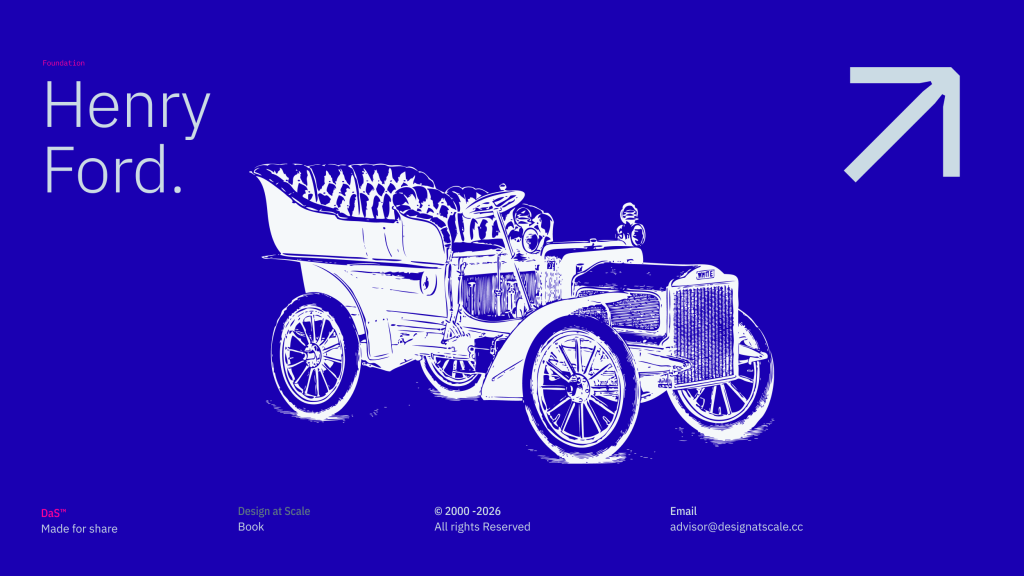
Henry Ford saw this tension early.

At the River Rouge Plant, he pioneered the modern assembly line - a symphony of moving parts where every worker, machine, and process played a precise role. The system didn’t just make cars faster; it made them reliable.
BOK – Landscape.

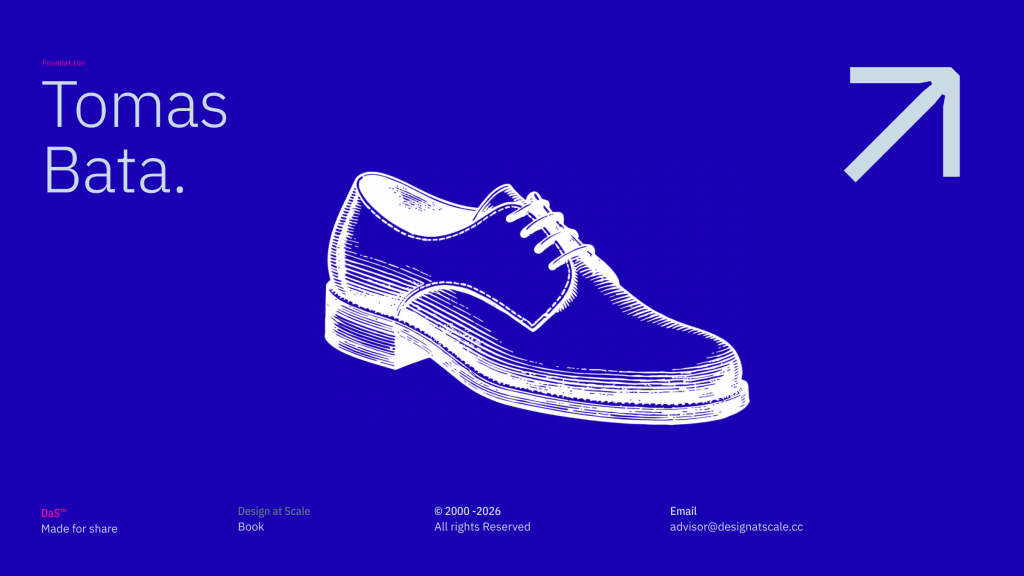
Across the Atlantic, another visionary, Tomáš Baťa in Czechoslovakia, observed a similar principle. His shoe factories were experiments in distributed innovation. Every part of the process - from stitching to packaging - was modular but synchronised. Each component evolved independently as long as it delivered to the main line on time.

That was the genius: a system designed for both speed and evolution.

These industrial models didn’t just change manufacturing. They redefined the architecture of modern design. They showed that scale wasn’t about headcount - it was about structure.

And while much has changed - from factories to Figma - the same logic applies.

Today’s design teams mirror those early production lines. The “stations” are now research, prototyping, testing, and delivery. The product might be digital, but the underlying mechanics of efficiency, communication, and iteration remain.

Understanding that lineage isn’t nostalgia. It's a strategy.

Because every design system, every sprint, every “agile” framework is built on principles first forged by people who made cars, shoes, and bridges - not interfaces.

And as we’ll see in the next sections, those foundations - Ford, Toyota, Baťa - still hold the blueprint for how design scales today.
Design at Scale™ Your Story Matters

Happy scaling through design!

Hey, I’m Jiri Mocicka.
London-based Product Design Director, Trusted Advisor and Author of Design at Scale™. The method that empowers individuals to shape the future organisation through design.
If you have a question, join our Community and reach out to like-minded individuals who scale design propositions. An online Academy can help you to define teams of 01, 10, and 100, and 1% supported by Grid Magazine and Supply section, where we bring more insights weekly on how to become a design leader in your Agentic Organisation

Author's Name

AVATAR

inResearch

42

inWriting

70

Released

235
EMT

Related.

Featured Image
It’s a common misconception that Henry Ford invented the automobile.The reality is, he didn’t. What he did invent was scale, however.  Ford’s true genius …
February 19, 2025
 · 
3 min read
Featured Image
In early 2026, we all saw some experiments and prototypes in which one node connected to another could transform an image into a series …
January 6, 2026
 · 
6 min read
Featured Image
Design has never stood still. Over the past century, it has transformed again and again. Each shift in form or function reflects a deeper …
January 1, 2025
 · 
4 min read
Featured Image
Since the early 2000s, the demand for designers has surged. As technology moved fully into digital, designers were forced to evolve with it. We …
January 8, 2025
 · 
3 min read
Featured Image
In the early 1900s, a cobbler knew every curve and stitch of the shoe they made. They built by hand, understood materials intimately, and …
January 22, 2025
 · 
3 min read
Featured Image
Most designers spend 80% of their time promoting their skills and only 20% sharpening them. It’s as if we’re all waiting for a design …
February 5, 2025
 · 
3 min read
Featured Image
Remember the Design Director I mentioned earlier? The one who led by vision, not by title? They didn’t manage people - they managed direction. …
January 29, 2025
 · 
3 min read
Featured Image
Not every generation of designers is made equal. The Bauhaus movement, born in the political tension of interwar Europe, gave us the first modern …
January 15, 2025
 · 
3 min read
Featured Image
Welcome to the Jira for Designers series brought to you by Design at Scale™ – Academy. In a previous article, we discussed Design planning(↘︎Link) and …
March 27, 2023
 · 
6 min read

GRID Magazine

Explore OUR 
Articles

Every week we bring set of stories reflecting on communication, operation and technology.

Newsletter

Subscribe.

We share our 20 years of experience in creating, managing and scaling products and services that allow individuals to shape organisations through design.

Design at Scale™

LINE_MAGENTA_050_301

Categories

LINE_MAGENTA_050_301

Data

LINE_MAGENTA_050_301

Share

Internal

Collaborate

Resources

IBM PlexSan
Regular
Charcoal

Design at Scale™ is defined by three models, which form the Method. Each model operates in a different part of the business and collects and informs parties on design and engineering decisions that have a direct impact on the delivery.

All brands and trademarks presented on the Design at Scale™ website are owned by their relevant companies or agencies. The projects represent collaborations between designers, developers and product owners. Do not copy or publish any of the projects shown here without written approval from Design at Scale™ (alternatively GIVE™, 9V™) and/or relevant companies and agencies.

SOC_Twitter
SON_LinkedIn
SON_Instagram
SOC_-Medium
View