;

Design Shaping

Featured Image

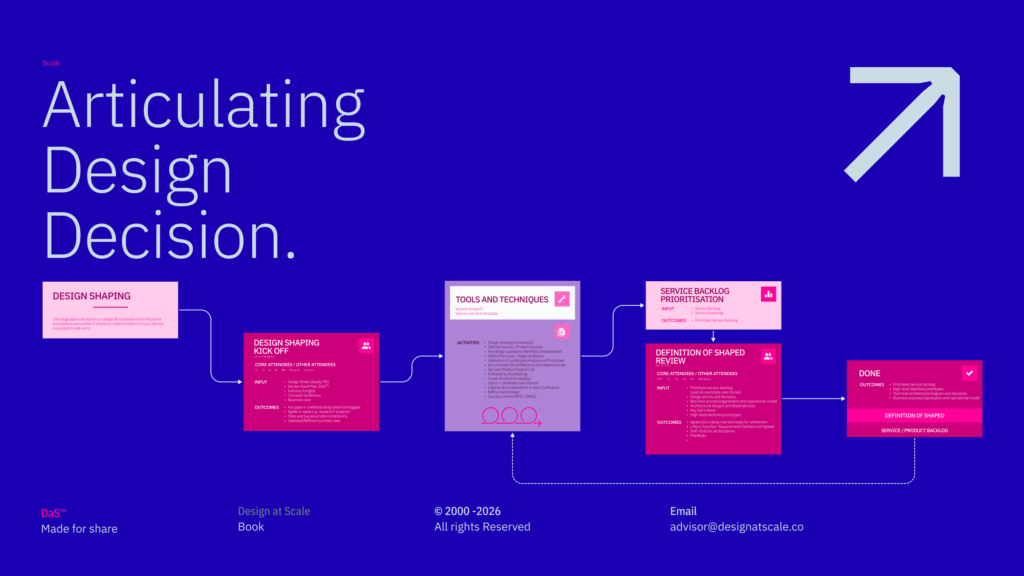
Design shaping validates and de-risks the proposition. It tests hypotheses, builds prototypes, explores mental models, and evaluates behaviours in realistic contexts. Every idea is treated as a hypothesis requiring evidence.

This phase begins with another workshop. At this point, senior leadership steps out and mid-to-executive management - department heads, programme managers, delivery leads - steps in. Their role is to break down the PID into high-level requirements and define acceptance criteria for both business and customer needs.

The team gathers insights, design guidelines, and relevant business cases, then stress-tests the proposition. Knowledge gaps are surfaced and resolved quickly so the team can move from outputs to outcomes. All actions are recorded in Jira, linked to epics and user stories.

Not every step requires documentation, but regulated industries (finance, insurance, healthcare) require formal traceability. Key decisions - those with material impact on outcomes - must be recorded to satisfy compliance and risk controls.
BOK — Design Shaping

The outcome of the first workshop is a refined business case, agreed high-level requirements, and structured epics.

Tools and techniques used in this phase include:

— Design shaping workshop
— Service or product journey definition
— Key design questions
— Personas
— Target audience definition
— Validation of landscape analysis
— Prototypes
— System-level agreements
— Architecture mapping
— Feature lists
— Backlog creation and prioritisation
— Documentation in Confluence linked to Jira
—Test strategy
— Success criteria
— KPIs and OKRs

These steps form the service backlog proposition - a functional map of what must be built. It becomes the foundation for prioritisation and release planning. This backlog is evidence-based, shaped by validated learning rather than assumptions.
BOK — Design Shaping

A shape review follows next. This is the organisation’s first formal handshake on the proposition. It reviews the backlog, design stories, dependencies, required integrations, and differences in business processes across teams. 

Architectural design dependencies - content model, layout, content strategy, and hierarchy - receive particular focus to ensure consistency and feasibility.

The team then establishes test criteria and prototypes that demonstrate the required behaviour and mental model. This continues until we reach definition readiness: high-level functional and non-functional requirements are clear, definitions of ready and done are agreed, and all disciplines align around a shared product manifesto.

At this point, the shape is defined. The work is ready to move into design delivery.

Happy scaling through design!

Hey, I’m Jiri Mocicka.
London-based Product Design Director, Trusted Advisor and Author of Design at Scale™. The method that empowers individuals to shape the future organisation through design.
If you have a question, join our Community and reach out to like-minded individuals who scale design propositions. An online Academy can help you to define teams of 01, 10, and 100, and 1% is supported by Grid Magazine and Supply section, where we bring more insights weekly on how to become a design leader in your Agentic Organisation

Jiri Mocicka

AVATAR

inResearch

87

inWriting

21

Released

300
EMT

Related.

Featured Image
This is how designers diagnose what needs fixing inside an organisation.  The Experience Map (DaS™ Canvas) translates the previous framework into a practical, decision-making …
August 13, 2025
 · 
8 min read
Featured Image
Integration is the final stage. Although development and QA test components weekly, integration consolidates all deployments into a cohesive, stable release. This stage ensures: …
August 6, 2025
 · 
1 min read
Featured Image
Show and Tell is an optional but highly recommended step. It creates organisational visibility and helps teams share progress without formal presentations or lengthy …
July 30, 2025
 · 
1 min read
Featured Image
Product delivery begins once design delivery establishes the foundation for engineering. In adaptive organisations, design and development run in parallel. Designers support engineering by …
July 23, 2025
 · 
1 min read
Featured Image
The purpose of proposition shaping is alignment. By the end of this stage, every discipline should hold the same documented understanding of the work: …
July 2, 2025
 · 
2 min read
Featured Image
A design philosophy is the belief system that guides how individuals and organisations make decisions, build systems, and shape outcomes. It is rooted in …
June 18, 2025
 · 
3 min read
Featured Image
Design at Scale™ is built on three core principles - the 3x3 - which frame how teams think, act, and deliver. Experience Great products …
June 11, 2025
 · 
2 min read
Featured Image
The core value of product design is not found in tools or methods, but in the approach applied to a problem. Design at Scale™ …
June 4, 2025
 · 
3 min read
Featured Image
A mindset is a set of assumptions and methods that guide how individuals or groups make decisions. To understand the mindset behind Design at …
May 28, 2025
 · 
2 min read

GRID Magazine

Explore OUR 
Articles

Every week we bring set of stories reflecting on communication, operation and technology.

Newsletter

Subscribe.

We share our 20 years of experience in creating, managing and scaling products and services that allow individuals to shape organisations through design.

Design at Scale™

LINE_MAGENTA_050_301

Categories

LINE_MAGENTA_050_301

Data

LINE_MAGENTA_050_301

Share

Internal

Collaborate

Resources

IBM PlexSan
Regular
Charcoal

Design at Scale™ is defined by three models, which form the Method. Each model operates in a different part of the business and collects and informs parties on design and engineering decisions that have a direct impact on the delivery.

All brands and trademarks presented on the Design at Scale™ website are owned by their relevant companies or agencies. The projects represent collaborations between designers, developers and product owners. Do not copy or publish any of the projects shown here without written approval from Design at Scale™ (alternatively GIVE™, 9V™) and/or relevant companies and agencies.

SOC_Twitter
SON_LinkedIn
SON_Instagram
SOC_-Medium
View