
Some organisations refer to this stage as “refinement,” but in practice it’s full design delivery. Where design shaping explores possibilities, design delivery translates those possibilities into production-ready detail.
This stage connects creative intent to technical execution. Designers shift from creative exploration to an engineering mindset - prioritising clarity, precision, and feasibility. The focus becomes preparing components, templates, scenarios, and specifications so development can move with minimal friction.
Design delivery often begins with templates built from containers, components, elements, and atoms. Refinement then breaks these templates down into discrete, reusable components that can be tokenised and consumed by engineering. Tokens (e.g., spacing, colour, typography) are exported as JSON and converted into CSS or platform-specific styles.
Behaviour-driven development (BDD) underpins the process. User stories are refined with explicit acceptance criteria, wireframes, prototypes, interaction notes, and data requirements. Every artefact aims to remove ambiguity and accelerate engineering delivery.
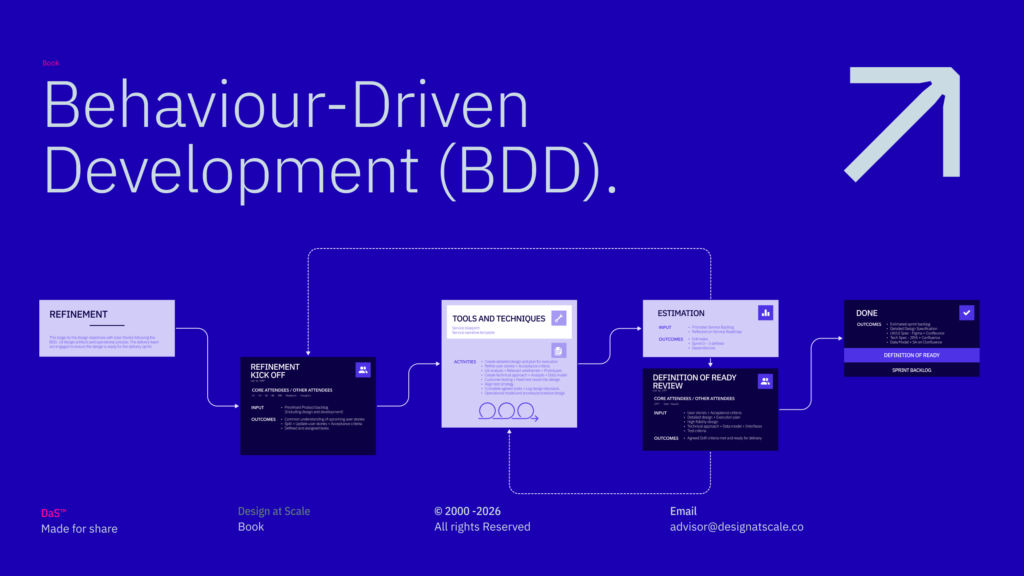
This phase is prioritised according to the delivery schedule. The team decides which components must be ready first, enabling development, testing, and code deployment to happen smoothly. This includes language variants, breakpoints, content limits, ratios, and spacing rules. The result is a refined, standardised design system that drives the final product.
Tools and techniques in this stage include:
— Detailed design planning
— Refined user stories
— Explicit acceptance criteria
— Integration of user analysis into stories
— Wireframes and prototypes
— Technical design approach
— Data model analysis
— Preparation for customer testing
— Testing script creation
— Alignment on testing strategy
— Completed design tasks
— Logged design decisions
— Operational model alignment with engineering
At the end of this stage, design and engineering align on final estimation. Product owners and Scrum masters size stories, define dependencies, and plan sprints. With design stabilised, engineering can focus on implementation rather than reacting to constant changes.
Each stage ends with a definition of ready review. At Design at Scale™, the Definition of Ready (DoR) is not a single-spec document - it’s instead a collaborative artefact that unites UX, UI, development, and content.
UI details and components live in Figma
Process notes and decisions in Confluence
Requirements, dependencies, and stories in Jira
Automation keeps these tools synchronised, avoiding duplication and reducing documentation overhead.
After design sign-off, UX and business partners document functionality, behaviours, data needs, and acceptance criteria. Engineering receives everything necessary for development: specifications, interaction notes, viewport rules, and test requirements.
This alignment ensures the team starts development with confidence, clarity, and shared accountability.




