;

Routine Over Gadgets

Featured Image

In the early 1900s, a cobbler knew every curve and stitch of the shoe they made. They built by hand, understood materials intimately, and saw the craft through from start to finish.

Today, a shoe designer might spend months on software like Autodesk Fusion, never setting foot in the factory. The work is efficient, distributed - yet, strangely disconnected.

Digital design followed the same path.

In the 1970s and ’80s, Design Directors were guardians of clarity. Their word set direction for magazines, books, and advertising. When they made a decision, the team aligned. There was confidence in the process because the stakes were real. Mistakes couldn’t be undone with a click; every choice mattered.

That respect for decision-making defined design leadership.

Now, the same title comes with less authority and more bureaucracy. Design Directors spend more time navigating systems than shaping them. Meanwhile, product designers chase efficiency, talking about “Agile” as if it were a religion.

The shift from paper to digital was supposed to give us freedom. Instead, it made us file managers. We fix, store, and search. We spend hours trying to find the latest version of something we already designed.

Then came the flood of tools.

From zip drives to cloud boards, plugins, filters, and version trackers. Design became a scavenger hunt. Everyone now has access to professional-grade software, which means everyone, theoretically, can be a designer.

But with that access came noise. We traded precision for convenience, composition for collaboration. We replaced layouts with emojis and Post-its and called it progress.

The outcome? We’ve mistaken activity for output.

Too many teams now work under the illusion that only the end result matters. They chase delivery speed, not design quality. The cost is staggering: roughly 80% of their energy disappears into coordination. Think: mock-ups, spreadsheets, hand-offs, exports, feedback loops across time zones, potentially too. 

If that sounds familiar, you’re not alone.

Selling speed is easy. You promise “faster to market,” and everyone nods. But what looks efficient in the short-term often burns productivity in the long run. Startups over-communicate to survive, hoping Slack will save them. Medium-sized businesses can move faster, but still bleed time and focus. Enterprises? They move like tectonic plates - slowly, expensively, and often in the wrong direction.

I once worked with a partner who began switching from PCs to MacBook Pros in 2016. It took them five years to move 300 designers over. Five years - to update hardware that changed annually. 

How painful is that? That’s not transformation. That’s inertia disguised as progress.

Technology moves too fast to control. The only constant you can design for is process. And the process lives in routine.
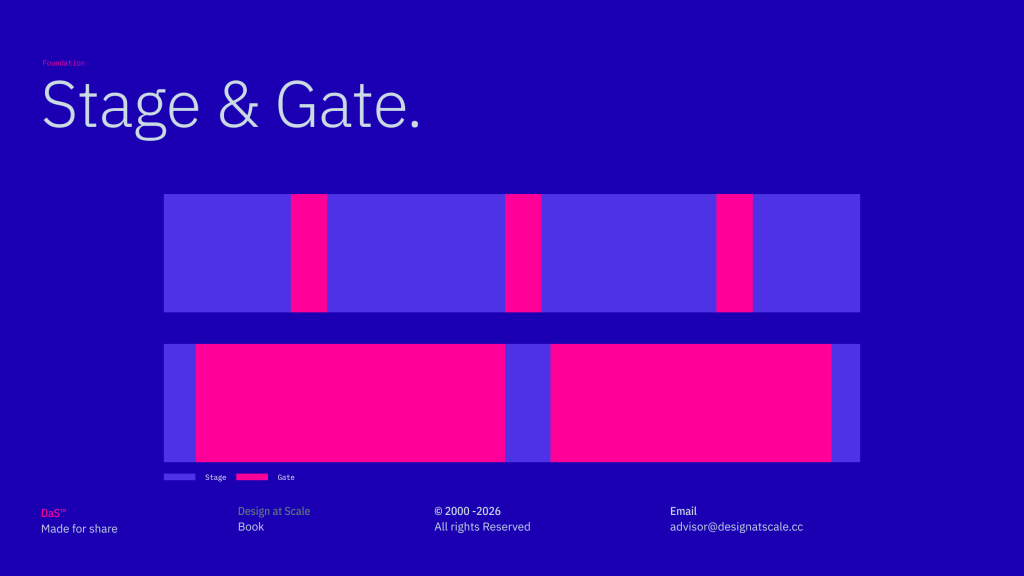
BOK – Routine 
Over Gadgets.
BOK – Routine 
Over Gadgets.

A good routine is the quiet infrastructure of creative work. It doesn’t limit you; it anchors you. Whether you lead a team or just contribute to one, routine gives rhythm to chaos.

You can’t stabilise an organisation overnight. But you can stabilise yourself. You can design your day with intent: how you start, how you decide, how you stop.

Sometimes that means nothing more radical than a 10 a.m. coffee before the storm begins. Because when the tools shift and the deadlines blur, it’s not the gadget that keeps you going. It’s a habit.
Design at Scale™ Your Story Matters

Happy scaling through design!

Hey, I’m Jiri Mocicka.
London-based Product Design Director, Trusted Advisor and Author of Design at Scale™. The method that empowers individuals to shape the future organisation through design.
If you have a question, join our Community and reach out to like-minded individuals who scale design propositions. An online Academy can help you to define teams of 01, 10, and 100, and 1% supported by Grid Magazine and Supply section, where we bring more insights weekly on how to become a design leader in your Agentic Organisation

Author's Name

AVATAR

inResearch

42

inWriting

70

Released

235
EMT

Related.

Featured Image
In early 2026, we all saw some experiments and prototypes in which one node connected to another could transform an image into a series …
January 6, 2026
 · 
6 min read
Featured Image
Design has never stood still. Over the past century, it has transformed again and again. Each shift in form or function reflects a deeper …
January 1, 2025
 · 
4 min read
Featured Image
Since the early 2000s, the demand for designers has surged. As technology moved fully into digital, designers were forced to evolve with it. We …
January 8, 2025
 · 
3 min read
Featured Image
Remember the Design Director I mentioned earlier? The one who led by vision, not by title? They didn’t manage people - they managed direction. …
January 29, 2025
 · 
3 min read
Featured Image
Most designers spend 80% of their time promoting their skills and only 20% sharpening them. It’s as if we’re all waiting for a design …
February 5, 2025
 · 
3 min read
Featured Image
Not every generation of designers is made equal. The Bauhaus movement, born in the political tension of interwar Europe, gave us the first modern …
January 15, 2025
 · 
3 min read
Featured Image
Welcome to the Jira for Designers series brought to you by Design at Scale™ – Academy. In a previous article, we discussed Design planning(↘︎Link) and …
March 27, 2023
 · 
6 min read
Featured Image
The most common interview opener is also the most commonly botched. Not because candidates lack a wealth of experience or confidence, but because they …
January 3, 2021
 · 
7 min read
Featured Image
Aligning Human Senses and Technical Communication to Unlock Enterprise Scale In a quickly evolving global corporate environment, cross-functional alignment is the ultimate metric of …
April 6, 2026
 · 
4 min read

GRID Magazine

Explore OUR 
Articles

Every week we bring set of stories reflecting on communication, operation and technology.

Newsletter

Subscribe.

We share our 20 years of experience in creating, managing and scaling products and services that allow individuals to shape organisations through design.

Design at Scale™

LINE_MAGENTA_050_301

Categories

LINE_MAGENTA_050_301

Data

LINE_MAGENTA_050_301

Share

Internal

Collaborate

Resources

IBM PlexSan
Regular
Charcoal

Design at Scale™ is defined by three models, which form the Method. Each model operates in a different part of the business and collects and informs parties on design and engineering decisions that have a direct impact on the delivery.

All brands and trademarks presented on the Design at Scale™ website are owned by their relevant companies or agencies. The projects represent collaborations between designers, developers and product owners. Do not copy or publish any of the projects shown here without written approval from Design at Scale™ (alternatively GIVE™, 9V™) and/or relevant companies and agencies.

SOC_Twitter
SON_LinkedIn
SON_Instagram
SOC_-Medium
View