If Ford industrialised production and Toyota humanised it, Tomas Baťa managed to socialise it.
In the early 1900s, the young Czech entrepreneur reimagined what an industrial organisation could be. His company in Zlín didn’t just make shoes, but it built a philosophy of work that blended autonomy, quality, and shared purpose.
The Baťa System, developed in the late 1920s and early 1930s, wasn’t about dividing tasks but about uniting people. It brought together design, production, and community under one idea:
“Leave thinking to the people, and labour to the machines.”
Baťa believed that progress belonged to everyone. Not just owners or engineers. His factories were experiments in self-management. Teams set their own targets, shared profits, and had a direct voice in decision-making. He cared deeply about the quality of life, building schools, housing, and sports facilities for employees. Work wasn’t just labour; it was participation in a shared system.
Ironically, Baťa’s vision began where Henry Ford’s ended.
Ford had written about worker autonomy and social responsibility in Today and Tomorrow and Knowledge in Action, but later abandoned those ideals in favour of rigid Taylorism. Baťa took the abandoned principles and turned them into practice.
The results were extraordinary. Productivity soared. Quality improved. The company remained agile, balancing craftsmanship with efficiency long before “agile” became a management cliché.
Baťa’s approach didn’t rely on control - it relied on trust.
Every team functioned as a self-governing unit, responsible for both profit and loss. This autonomy made employees think like entrepreneurs, not operators. Profit sharing wasn’t an annual bonus; it was a weekly exercise in ownership.
Baťa believed three things made this work:
Speed: Profits had to be calculated quickly.
Transparency: Everyone needed to understand how their share was earned.
Scale: Units had to be small enough that every worker could feel their impact.
It was a radical management structure - part factory, part cooperative - and it prefigured everything from lean startups to modern product squads.
At its height, the Baťa factories were vast but synchronised. Two main workshops, each 80 by 20 metres, produced over 2,000 pairs of shoes a day. Electric motors powered conveyor belts that moved semi-finished shoes between teams. Detailed daily plans ensured every worker knew the targets for their station. It was industrial choreography, precision without rigidity.
But Baťa’s system went deeper than logistics. It shaped culture.
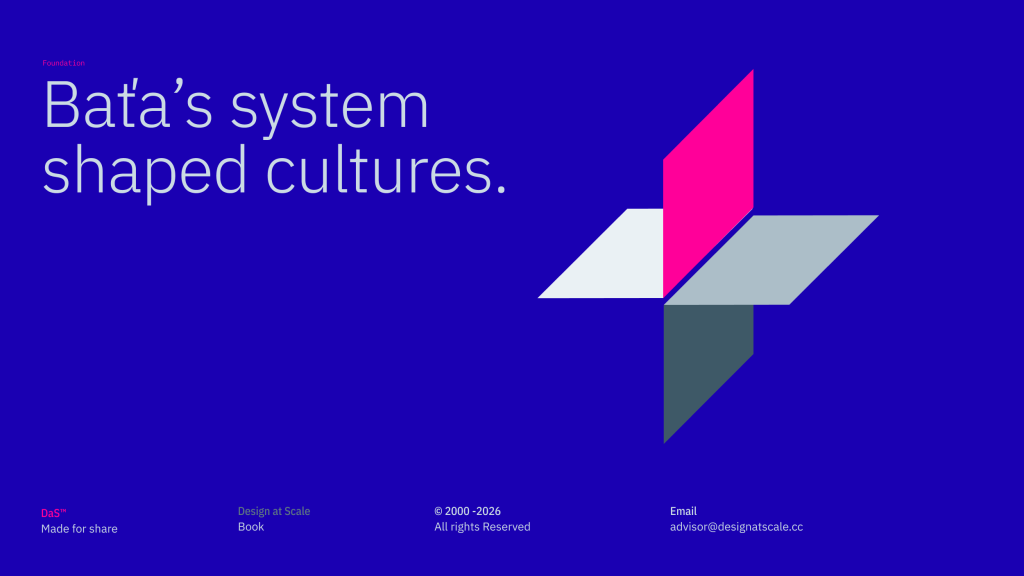
He recognised that true scale depends on shared understanding. Every organisation, he argued, is shaped by four interlocking elements:
Material - what it makes (its products and artefacts).
Social - how it behaves (its norms and values).
Cognitive - what it knows (its knowledge and innovation).
Institutional - how it governs itself (its rules and structures).
Culture, in Baťa’s view, wasn’t decoration. But it was infrastructure.
This idea aligned with thinkers like Karl Polanyi, who wrote in The Great Transformation (1944) that society evolves not just through machines but through the beliefs and behaviours they create. In Zlín, Baťa proved that industrial modernity could be built on community as much as machinery.
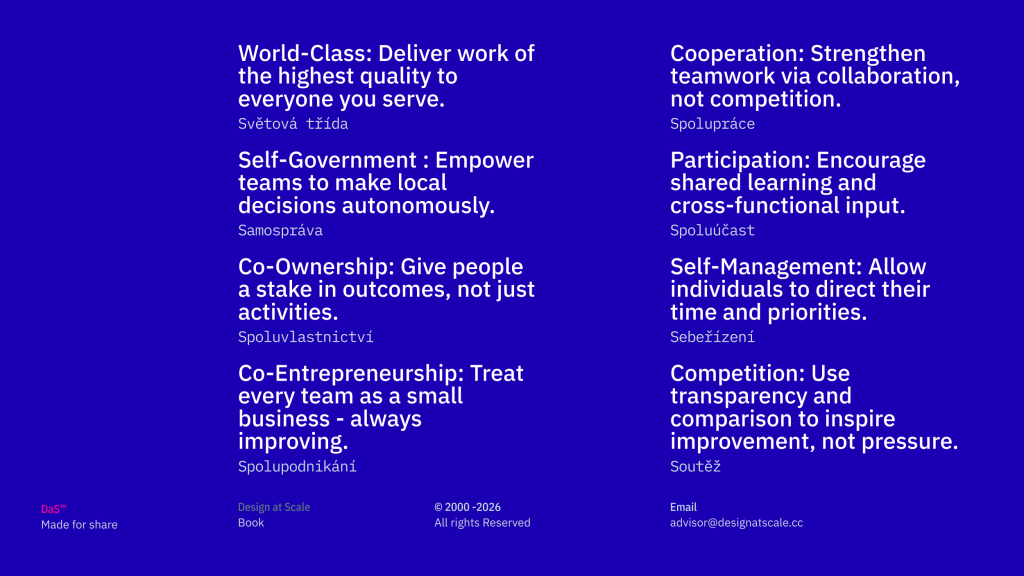
He even codified these values into his famous 8S Principles - the original Czech framework that later influenced corporate governance worldwide:
World-Class (Světová třída): Deliver work of the highest quality to everyone you serve.
Cooperation (Spolupráce): Strengthen teamwork through collaboration, not competition.
Self-Government (Samospráva): Empower teams to make local decisions autonomously.
Participation (Spoluúčast): Encourage shared learning and cross-functional input.
Co-Ownership (Spoluvlastnictví): Give people a stake in outcomes, not just activities.
Self-Management (Sebeřízení): Allow individuals to direct their time and priorities responsibly.
Co-Entrepreneurship (Spolupodnikání): Treat every team as a small business - always improving.
Competition (Soutěž): Use transparency and comparison to inspire improvement, not pressure.
Each principle reflected Baťa’s belief that efficiency without humanity is hollow. His workers weren’t cogs in a machine; they were co-authors of progress.
Baťa’s ideas were decades ahead of their time. After Nazi occupation in 1939 and later communist nationalisation, his system was dismantled. But his principles lived on through his family and global subsidiaries - influencing management thought across Europe, Canada, and India.
What makes the Baťa model remarkable isn’t its machinery. But the mindset.
While Ford scaled production and Toyota perfected process, Baťa scaled culture. He understood that the health of an organisation depends on how it thinks, behaves, and learns collectively.
He once recalled his early visits to the United States:
“I worked as a factory labourer myself. I realised that telling people what to do is useless if you cannot demonstrate it.”
That humility became his competitive advantage. By blending leadership with participation, Baťa created not just a company but a movement.
His legacy is visible in every modern business that values autonomy, continuous learning, and shared ownership.
The lesson is simple: structure can drive scale, but culture sustains it.
Design at Scale™ takes the same view. Systems matter, but they must serve people. Because when you give thinking to the people, and labour to the machines, progress becomes inevitable.