In 1945, Kiichiro Toyoda set his company a challenge: Catch up to America.
At the time, Japan had few resources and even fewer machines. The United States was thriving on mass production - stamping out millions of identical products at industrial speed. But Japan couldn’t compete on volume. Its only option was to compete on precision.
Toyoda’s insight was simple but revolutionary at the same time: if Japan couldn’t outproduce the West, it could out-think it.
He proposed a system where parts would arrive just when they were needed. And never before. No warehouses, no mountains of unused stock, no waste. This was the seed of what would become the Toyota Production System (TPS).
Kiichiro Toyoda didn’t live to see it realised. But his vision reshaped global manufacturing.
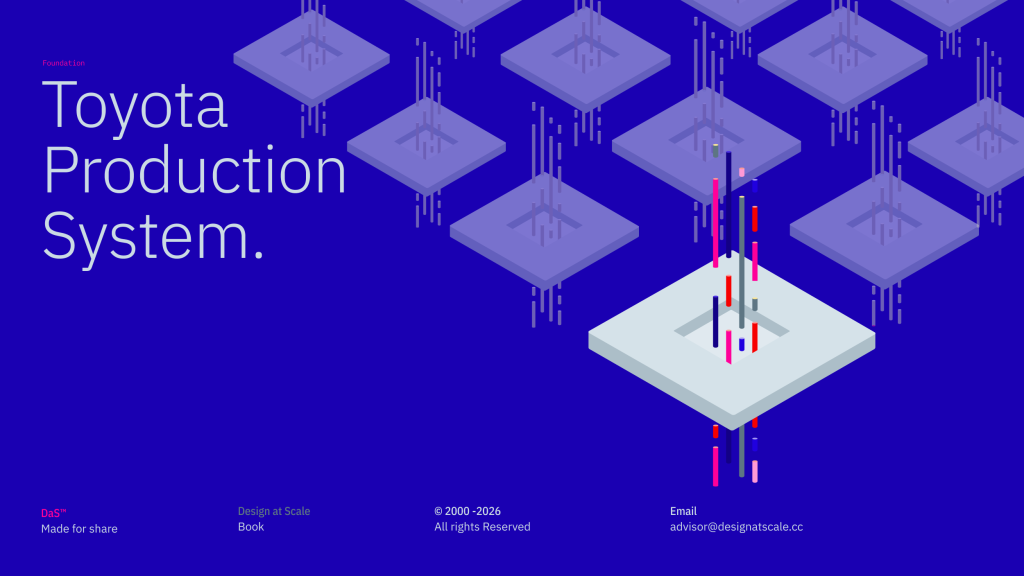
By 1962, Toyota had formalised the system around two core ideas: Just-in-Time and Jidoka.
Just-in-Time meant synchronising every stage of production so precisely that materials arrived exactly when required - never too early, never too late. Jidoka meant “automation with a human touch”: empowering workers to stop the line whenever they spotted a problem, ensuring quality was built in, not inspected later.
Together, these principles created a self-correcting ecosystem — efficient, intelligent, and humane.
But the true engine of Toyota’s success wasn’t technology; it was philosophy.
TPS introduced a concept that would change how teams think forever: Kaizen — continuous improvement.
Kaizen is about small, consistent progress. It assumes that the best people to improve a system are the ones inside it. Every employee — from factory worker to executive — is responsible for suggesting better ways to work. The idea isn’t to chase perfection, but to keep moving toward it.
At the heart of Kaizen sits the PDCA cycle, popularised in Japan by statistician W. Edwards Deming.
— Plan - Identify a goal or problem and design a small experiment.
— Do - Implement the change.
— Check - Measure the result.
— Act - Standardise the improvement or begin again.
— Then repeat - forever.
It’s deceptively simple. But PDCA transformed how Toyota and, later, entire industries approached innovation. It turned improvement into a daily habit rather than a yearly initiative.
Leaders didn’t hand down orders; they set direction. Teams took ownership of the journey. Progress became collaborative, not hierarchical.
The system spread quietly until 1990, when a team of MIT researchers published The Machine That Changed the World. Their study revealed that Toyota’s method consistently outperformed Western mass production in cost, quality, and speed. They called this approach “lean production.”
What made it lean wasn’t the absence of waste — it was the presence of wisdom.
Toyota proved that you don’t scale by working harder or faster; you scale by working smarter.
Every process was a living organism — monitored, adapted, and refined. Every failure was a signal, not a setback.
This mindset - humble, curious, relentlessly improving - became the philosophical backbone of modern design systems.
Design at Scale™ inherits the same principle.
We don’t build perfect systems; we build systems that learn.
We don’t chase speed for its own sake; we pursue rhythm, clarity, and alignment.
And like Toyota, we trust that those closest to the work - the designers themselves - hold the knowledge to improve it.
Because the power of scale isn’t in producing more. It’s in producing better, together, continuously.