;

This Is Not a Revolution

Featured Image

Most designers spend 80% of their time promoting their skills and only 20% sharpening them. It’s as if we’re all waiting for a design revolution that never quite arrives.

The market is crowded, the tools evolve weekly, and the pace feels impossible. You can’t grow if you’re constantly readjusting to new methods, systems, or titles. Between keeping up with software, monitoring trends, and managing stakeholders, it’s a wonder anyone still designs at all.

We’ve mistaken motion for momentum.

The truth is, design isn’t at war with the rest of the product team. We’re not fighting for territory. We’re supporting the mission. The best design leaders know this. They align, translate, and elevate the work so that everyone moves together.

But the ecosystem we’ve built makes that harder than it should be. Every new tool, process, and framework promises acceleration, but what we actually need is focus.

On the Design at Scale™ Academy, seven out of ten questions sound the same:
“How do I do more?”
“How can I deliver faster?”
“How can I achieve more impact?”

The obsession is always more.
More tools, more outputs, more deliverables. Rarely does anyone ask the more important question: what’s the value of what I’m producing?

Output-driven design is the great modern illusion.

A designer might deliver 100 screens in a sprint, but if none of them shifts behaviour, what have we achieved? Efficiency without impact is just expensive motion.
BOK – This Is Not 
a Revolution

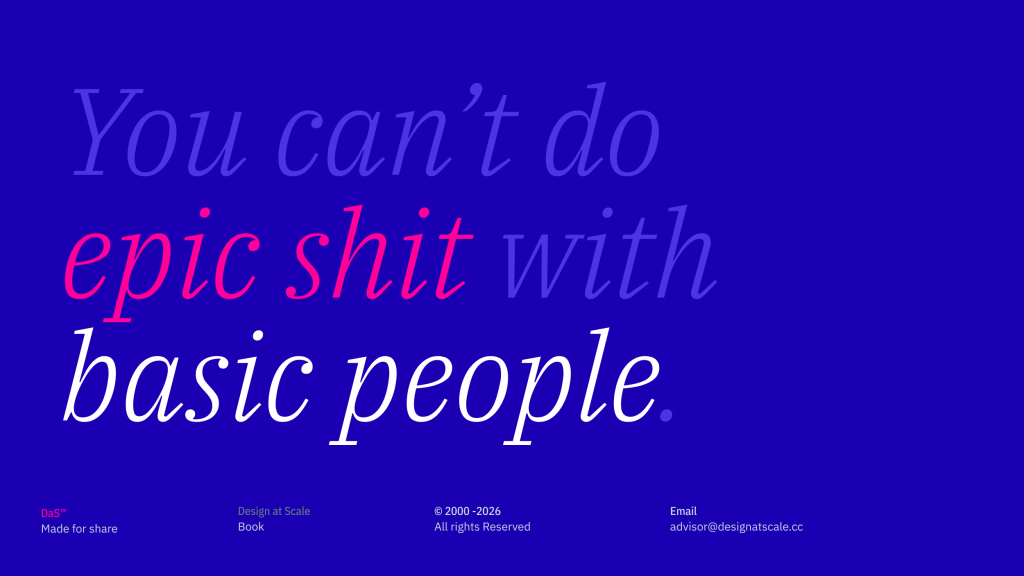
There’s a phrase that captures this perfectly: “You can’t do epic shit with basic people.”

If you sell your skills to clients who measure only output, time, and cost, you’ll rarely produce anything meaningful. You’ll be valued for your speed, not your insight. You could deliver brilliant thinking on a single screen - reducing a process from 27 steps to seven - and still be told it wasn’t enough to justify the fee.

The problem isn’t the work; it’s the way we frame it. When value is defined by volume, quality becomes invisible.

That’s why Design at Scale™ distinguishes between two archetypes: Mercenaries and Missionaries.

Mercenaries deliver quickly and move on. They bring efficiency, not depth. They’re perfect for execution-heavy environments - fast, flexible, disposable. A single designer might produce twenty screens in twenty hours for £200. If no revisions are needed, great. If they are, chaos ensues.

Missionaries, on the other hand, are strategic specialists. They don’t just design - they shape the system around design. They understand the industry, optimise processes, and build trust. Their work has long-term impact: fewer revisions, better outcomes, stronger teams. They cost more, but they return more.

One isn’t better than the other. You need both.

Mercenaries create speed; Missionaries create stability. The trick is integration - balancing agility with depth, delivery with direction.

A healthy design organisation scales by combining them: Missionaries define the path; Mercenaries keep it clear.

That’s not revolution - that’s maturity.

Because at scale, design isn’t about rebellion. It’s about rhythm. It’s not about fighting for relevance - it’s about proving value through clarity, focus, and alignment.

In the end, no tool or process can replace that.

Design doesn’t need another uprising. It needs designers who know what they stand for - and teams smart enough to let them lead.
Design at Scale™ Your Story Matters

Happy scaling through design!

Hey, I’m Jiri Mocicka.
London-based Product Design Director, Trusted Advisor and Author of Design at Scale™. The method that empowers individuals to shape the future organisation through design.
If you have a question, join our Community and reach out to like-minded individuals who scale design propositions. An online Academy can help you to define teams of 01, 10, and 100, and 1% supported by Grid Magazine and Supply section, where we bring more insights weekly on how to become a design leader in your Agentic Organisation

Author's Name

AVATAR

inResearch

42

inWriting

70

Released

235
EMT

Related.

Featured Image
In early 2026, we all saw some experiments and prototypes in which one node connected to another could transform an image into a series …
January 6, 2026
 · 
6 min read
Featured Image
Design has never stood still. Over the past century, it has transformed again and again. Each shift in form or function reflects a deeper …
January 1, 2025
 · 
4 min read
Featured Image
Since the early 2000s, the demand for designers has surged. As technology moved fully into digital, designers were forced to evolve with it. We …
January 8, 2025
 · 
3 min read
Featured Image
In the early 1900s, a cobbler knew every curve and stitch of the shoe they made. They built by hand, understood materials intimately, and …
January 22, 2025
 · 
3 min read
Featured Image
Remember the Design Director I mentioned earlier? The one who led by vision, not by title? They didn’t manage people - they managed direction. …
January 29, 2025
 · 
3 min read
Featured Image
Not every generation of designers is made equal. The Bauhaus movement, born in the political tension of interwar Europe, gave us the first modern …
January 15, 2025
 · 
3 min read
Featured Image
Welcome to the Jira for Designers series brought to you by Design at Scale™ – Academy. In a previous article, we discussed Design planning(↘︎Link) and …
March 27, 2023
 · 
6 min read
Featured Image
The most common interview opener is also the most commonly botched. Not because candidates lack a wealth of experience or confidence, but because they …
January 3, 2021
 · 
7 min read
Featured Image
Aligning Human Senses and Technical Communication to Unlock Enterprise Scale In a quickly evolving global corporate environment, cross-functional alignment is the ultimate metric of …
April 6, 2026
 · 
4 min read

GRID Magazine

Explore OUR 
Articles

Every week we bring set of stories reflecting on communication, operation and technology.

Newsletter

Subscribe.

We share our 20 years of experience in creating, managing and scaling products and services that allow individuals to shape organisations through design.

Design at Scale™

LINE_MAGENTA_050_301

Categories

LINE_MAGENTA_050_301

Data

LINE_MAGENTA_050_301

Share

Internal

Collaborate

Resources

IBM PlexSan
Regular
Charcoal

Design at Scale™ is defined by three models, which form the Method. Each model operates in a different part of the business and collects and informs parties on design and engineering decisions that have a direct impact on the delivery.

All brands and trademarks presented on the Design at Scale™ website are owned by their relevant companies or agencies. The projects represent collaborations between designers, developers and product owners. Do not copy or publish any of the projects shown here without written approval from Design at Scale™ (alternatively GIVE™, 9V™) and/or relevant companies and agencies.

SOC_Twitter
SON_LinkedIn
SON_Instagram
SOC_-Medium
View