The core value of product design is not found in tools or methods, but in the approach applied to a problem. Design at Scale™ reframes the design function as a strategic engine. One that generates revenue, reduces cost, increases efficiency, and strengthens competitiveness. When centred on the user, design creates value that compounds across the entire organisation.
Driving Revenue and Market Share
Design directly affects top-line performance.
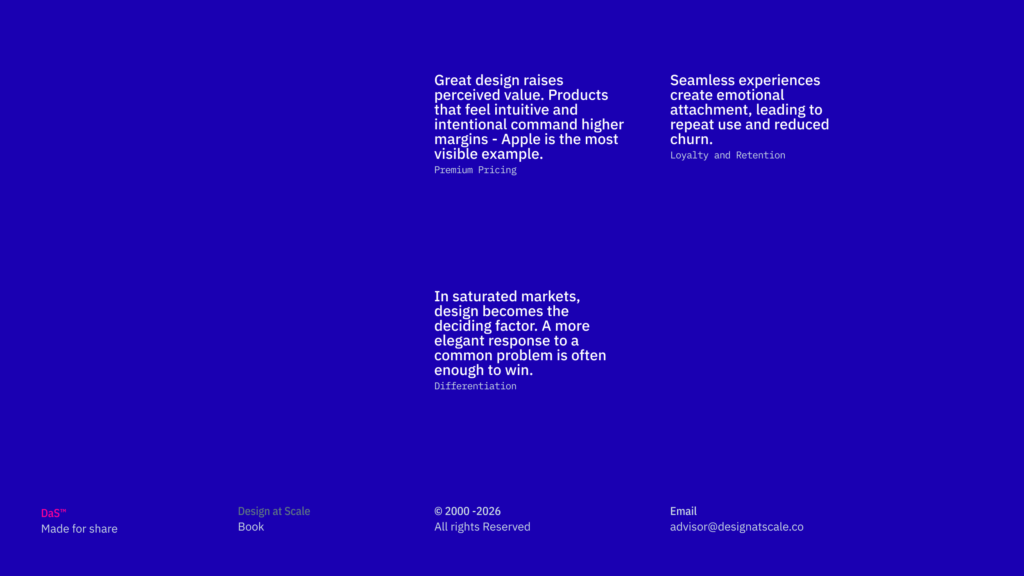
Premium Pricing: Great design raises perceived value. Products that feel intuitive and intentional command higher margins - Apple is the most visible example.
Loyalty and Retention: Seamless experiences create emotional attachment, leading to repeat use and reduced churn.
Differentiation: In saturated markets, design becomes the deciding factor. A more elegant response to a common problem is often enough to win.
Reducing Costs and Increasing Efficiency
Design cuts unnecessary expense before it occurs.
Lower Development and Support Costs: Research and prototyping expose issues early, reducing rework and lowering support tickets.
Faster Time to Market: Reusable components and unified guidelines allow teams to ship consistently and at speed.
Brand Cohesion: Shared identity reduces redesign cycles and simplifies marketing.
Fostering Innovation and Strategy
Design strengthens decision-making across the business.
Better Insight: Understanding user behaviour leads to clearer strategy, smarter bets, and more viable propositions.
Alignment: A user-centred culture breaks down departmental silos and unifies teams behind one experience.
Adaptability: Design-led organisations iterate naturally, responding to market change without structural friction.
Customer Collaboration
Across all delivery methods, customer insight remains the most reliable decision-making tool. Integrating Insights, Research, and Quality Assurance Engineering is essential to maintain alignment and validate behaviour-based requirements. But customer involvement must be outcome-driven, not output-driven - otherwise teams resist change instead of learning from it.
Continuous Iteration
The first Agile value - individuals and interactions over processes and tools - applies directly here. Protecting collaboration does not mean avoiding documentation; it means documenting intelligently.
Shared knowledge bases (Confluence or similar) allow teams to capture decisions as they go, turning iteration into institutional memory. This strengthens transparency and accelerates responses between business, product, and design.
Prototypes and Software
Historically, documentation attempted to replace conversation - hundreds of pages of specifications that were outdated before they reached development. Modern design reverses that: the prototype becomes the documentation.
Tools like Figma enable teams to:
— iterate quickly
— communicate changes instantly
— align with engineering from day one
— reduce refactoring by making intent visible
A strong knowledge base consolidates design specifications (fonts, colours, layouts, patterns, mental models) with technical requirements (test plans, behaviours, approvals) in one accessible location.
Documentation becomes a natural by-product of delivery, not an additional task.
Change and Response
Design has always leaned toward holistic thinking, but software development often requires incremental change. To bridge the two, Design at Scale™ relies on behaviour-based outcomes, not static deliverables. This prevents large, disruptive design shifts later in the process.
Prototypes test hypotheses, automation removes unnecessary admin work, and communication channels stay open. If a team spends energy maintaining parallel spreadsheets, multiple reporting tools, and duplicate status updates, they are not responding to change - they are drowning in process.
Design at Scale™ creates a single, actionable communication stream. Conversation can happen anywhere, but the alignment lives in one place. Over time, that discipline compounds into clarity, speed, and trust.