The twentieth century didn’t just change what we made. Instead, it changed how we worked together. When someone says, “Let’s throw some people at it,” what they really mean is: add headcount, not insight. A bit like throwing something at a wall and hoping it will stick.
That thinking shaped much of the last century - and design hasn’t been immune.
As industries scaled, the old giants like Ford, Coca-Cola, Levi’s, and Kodak gave way to new players - IBM, GE, Atari, Microsoft, Apple. Growth meant volume. Volume meant visibility. Visibility demanded advertising. And advertising demanded design that could move as fast as the market.
Big agencies evolved alongside these brands, building new delivery models to keep up. They weren’t just producing campaigns; they were engineering processes - blending design, operations, and communication into an early form of organisational integration.
But with growth came fragmentation. Local agencies ran local work. Reuse and consistency barely existed. A family on one coast rarely saw the same ad as another. Each region interpreted the brand in its own dialect.
It wasn’t until the internet that everything converged. Suddenly, every brand needed a single face - everywhere, in every language. Centralised websites replaced regional campaigns. Design systems replaced design departments.
The world had become integrated. But not necessarily coordinated.
Horizontal Integration
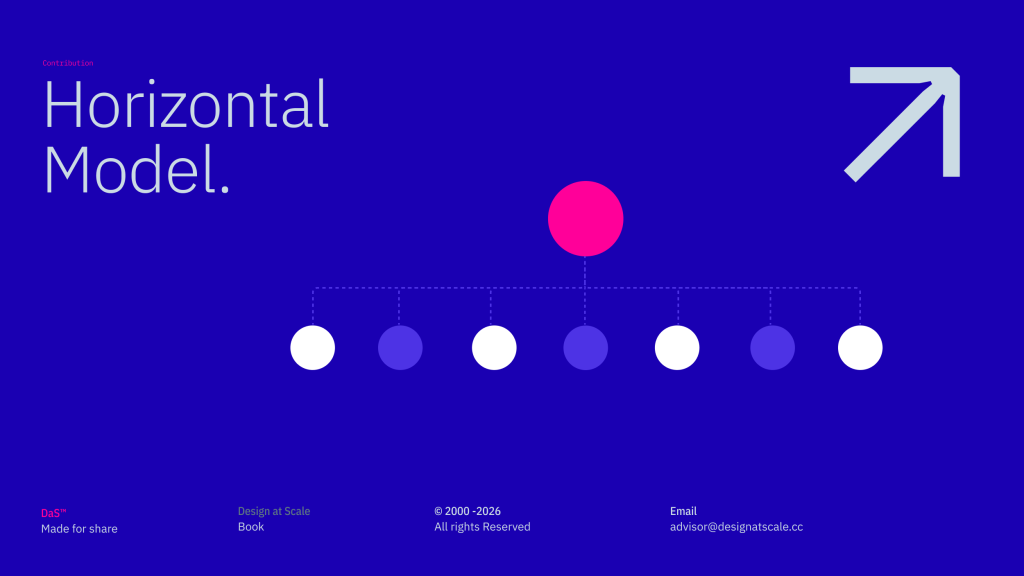
Horizontal integration was the first wave of growth.
A business expanded by adding new products or markets - widening, but not deepening. If one product sold, another followed. A shoe store became a shoe company. A local brand became a national one.
But horizontal growth has limits. Every new product requires a new team, a new supply chain, a new message. You can sell more, but you can’t necessarily connect more.
For design, it’s the difference between running multiple projects and building a platform. You grow wider, not smarter.
Vertical Integration
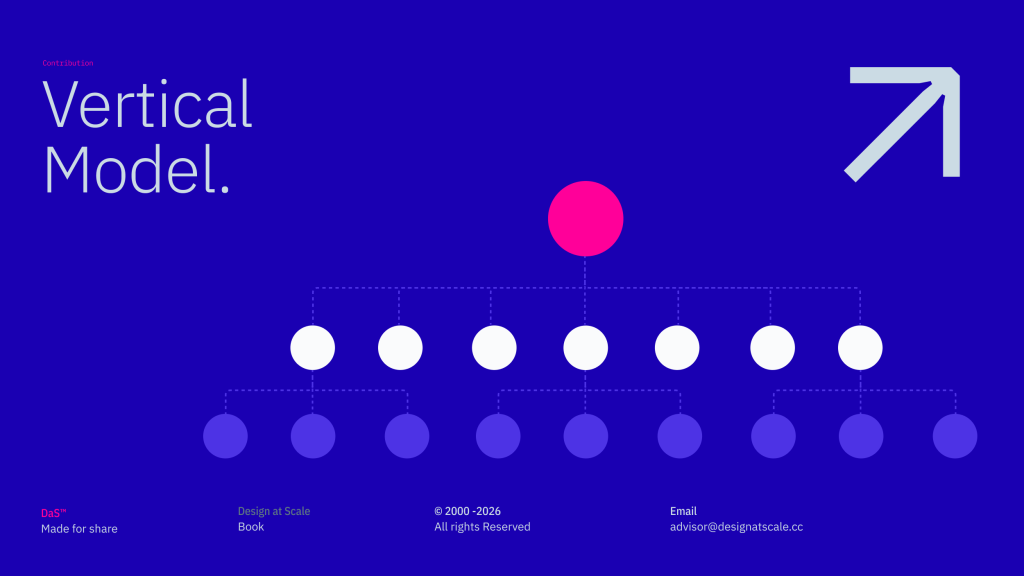
Then came vertical integration - companies expanding up and down their value chains.
Factories opened franchises, brands controlled distribution, and retail became an empire. From the 1950s to the 1980s, this was how you scaled: own more of the journey from creation to consumption.
But it introduced a new challenge. This was coherence.
Each franchise hired its own agency. Each agency built its own design language. Consistency became chaos. Costs rose, messages clashed, and brands diluted themselves trying to manage it all.
By the 1990s, the internet promised to fix this. It didn’t. It just made the inconsistency visible in real time.
Design decisions made on the West Coast could define user experiences in Europe or Asia — often without context.
“Global coordination became a paradox: everyone connected, no one aligned”.
Functional Integration
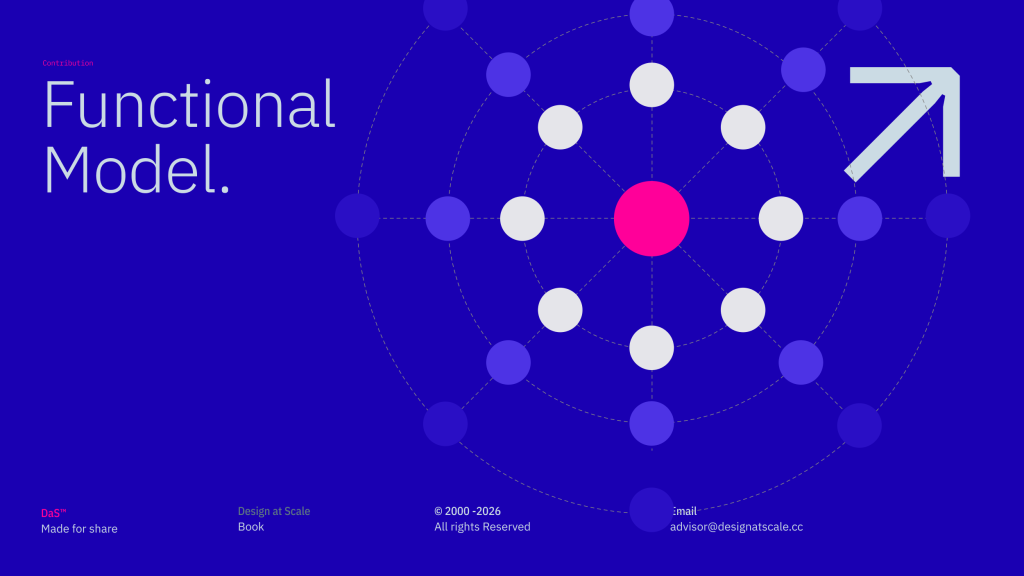
Functional integration was the next evolution. And the one that most resembles today’s design maturity.
Instead of simply expanding output, companies began connecting functions. Products, services, and data began to inform one another.
Knowledge became the shared infrastructure.
Teams learned to treat information as capital. Meaning something to be invested, refined, and redistributed. Without that shared understanding, organisations couldn’t adapt fast enough to stay relevant.
But adaptation isn’t comfortable. Even startups struggle with perpetual change. Functional integration demands a new kind of discipline: teams that learn faster than they build.
Take the shoe industry again.
Baťa’s factories were masters of efficiency - linear, predictable, built for volume. But they couldn’t scale functionally. Their systems were optimised for production, not learning.
Nike, by contrast, designed its business like a feedback loop. The company merged digital and physical experiences long before “omnichannel” was a buzzword. Data from Nike Run and FuelBand (now Apple Watch) feeds directly into product design and marketing. The result is a living brand — part software, part sport, part social ecosystem.
“Nike doesn’t just sell shoes; it sells participation. That’s functional integration - a company that learns in real time”.
Exponential Integration
The latest evolution is Exponential Integration - a term popularised by Salim Ismail, Peter Diamandis, and Michael Malone in Exponential Organisations.
They identified eleven attributes shared by the world’s most adaptive companies: Massive Transformative Purpose, Staff on Demand, Community and Crowd, AI and Algorithms, Leveraged Assets, Engagement, Interfaces, Dashboards, Experimentation, Autonomy, and Social Technologies.
Individually, they’re tools. Together, they form a mindset.
Exponential organisations don’t just optimise operations, but they reinvent them continuously. They grow by learning faster than scale can limit them.
What connects these companies isn’t size; it’s velocity of intelligence.
They use data, automation, and community not to replace people, but to amplify them. Their systems think, adapt, and evolve - just like organisms, but not like factories.
In practice, this means reimagining how design operates inside business.
Design at Scale™ sits at the centre of this shift. It’s where disciplines intersect - where engineering meets emotion, and data meets meaning. Everyone wants a piece of that clarity, which is why so many teams now borrow design frameworks for their own processes.
And that’s fine - as long as design remains the connective tissue, not the casualty.
Because design’s real power isn’t ownership. It’s orchestration.
We’re not here to defend territory; we’re here to define flow.
Integration - horizontal, vertical, functional, or exponential - isn’t just a management model. It’s a mindset that values knowledge over control, learning over hierarchy, and connection over competition.
When design operates at that level, it stops being a department and becomes what it was always meant to be: a system of intelligence, shaping how everything else works.